



The AI scrum master that works from what your team actually shipped
Troopr forms its own view of the sprint from your team's real activity, writes each person's standup, runs the ceremonies, and proposes the Jira updates for whoever owns the work to confirm in one tap.
Free for 10 seats . No credit card required. Runs in Slack & Microsoft Teams
Trusted by 600+ engineering teams worldwide
Scrum runs on what gets reported.
Your team runs on what shipped.
Work is discussed in chat, tracked in Jira, and shipped in GitHub. Keeping all three telling the same story is manual, constant, and it lands on you.
Status is self-reported
A standup gives you what people remembered to say, filtered through what they felt like saying. Not a view you can take into planning.

86% of status-meeting time gone
The board drifts from reality
A PR merges while the ticket says in progress. A decision in a thread never reaches Jira. Sprints stop burning down and leadership stops trusting the board.

67% less time in Jira
You become the relay
Chasing updates, translating threads into tickets, assembling status before a review. The parts of the job that need judgment get whatever is left.
%201.svg)
3.8 hrs/week back for managers
Most of the scrum master job is reconciliation
Work lives in chat, in the tracker, and in the code, and the three never agree on their own. Someone keeps them matching. Troopr does that continuously, and nobody reports on themselves to make it happen.
- Chasing people for standup updates
- Copying decisions out of threads into tickets
- Copying decisions out of threads into tickets
- Copying decisions out of threads into tickets
It reads the work, then does the coordination
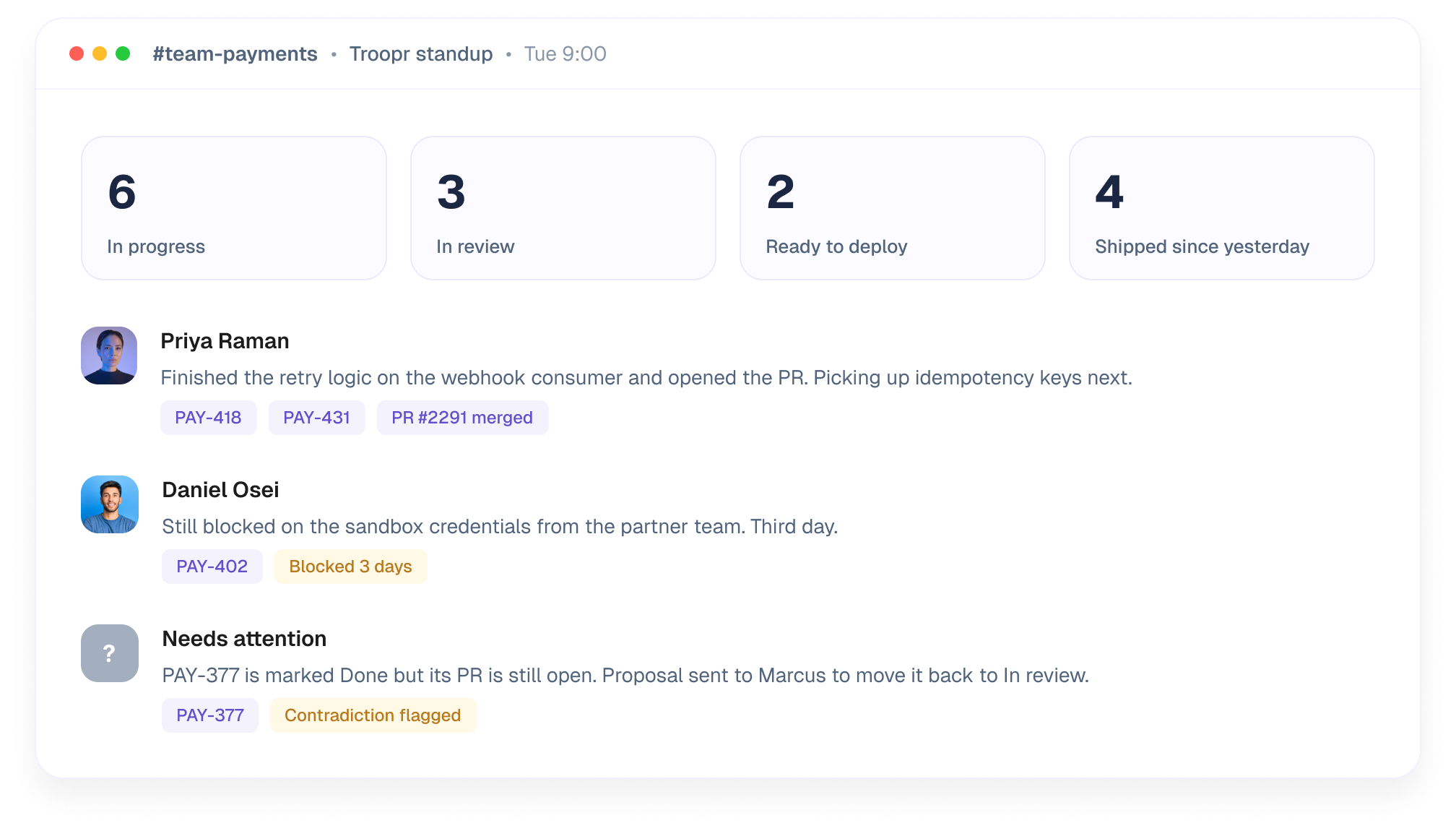
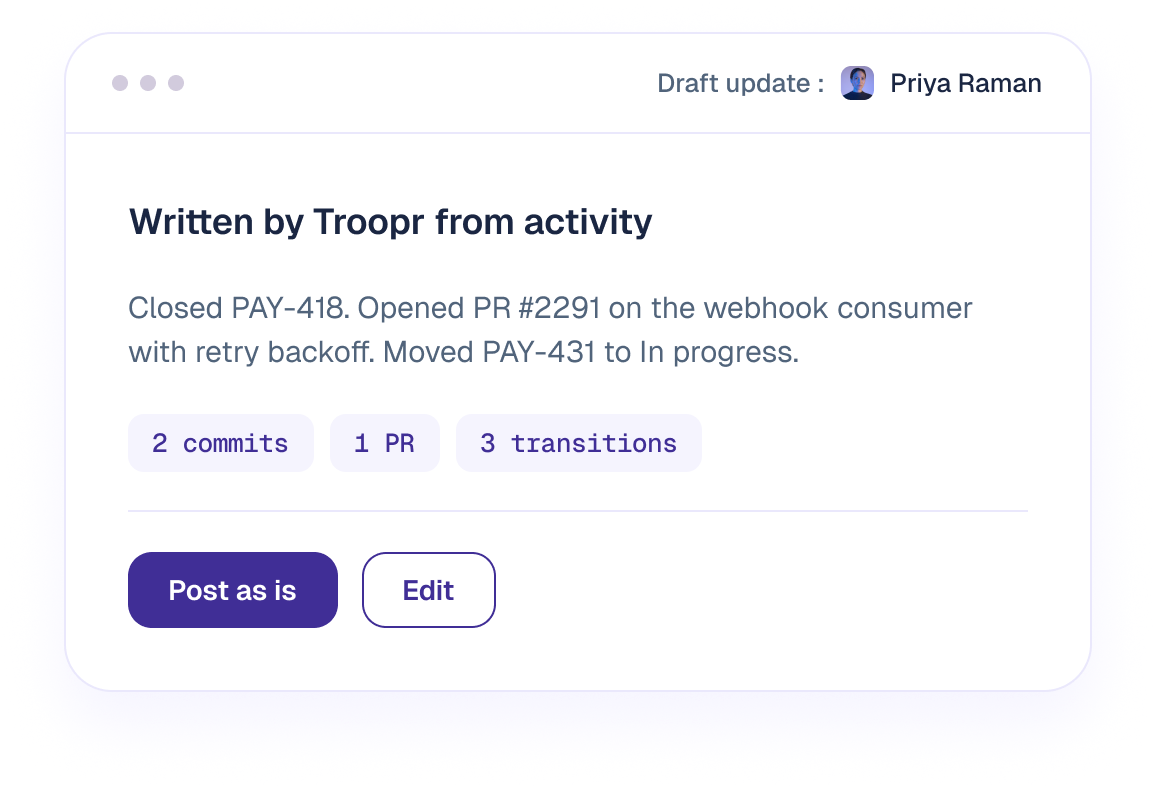
The standup writes itself
Troopr drafts each person's update from the issues they moved and the code they pushed, including what the diffs actually changed. It asks someone directly only when it genuinely cannot tell. Every report carries a read on the day and a needs-attention section naming specific people and specific items.
Snowflake: 86% of weekly status-meeting time eliminated
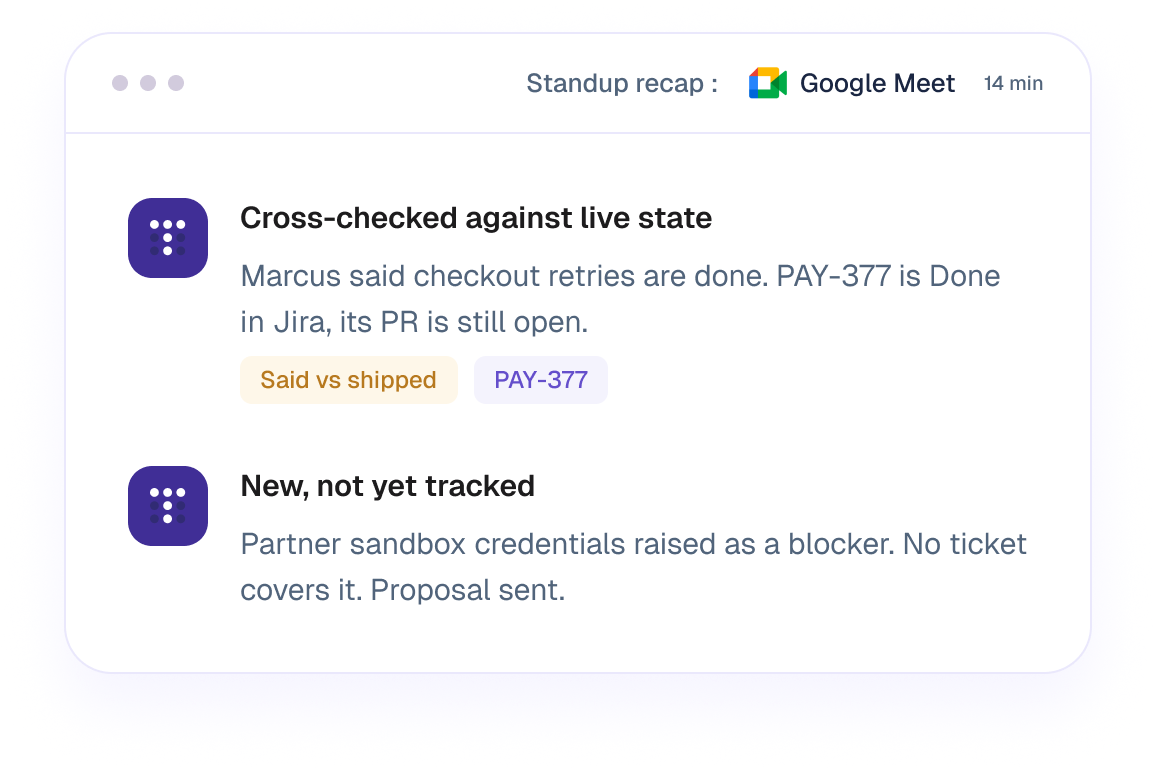
Keep the live standup if the team wants it
Troopr joins on Google Meet, Zoom, or Microsoft Teams, announces itself, listens, and posts the recap. It does not speak or facilitate. Because it already holds your history and live state, the recap flags the ticket called done that is still in review, not just what was said.
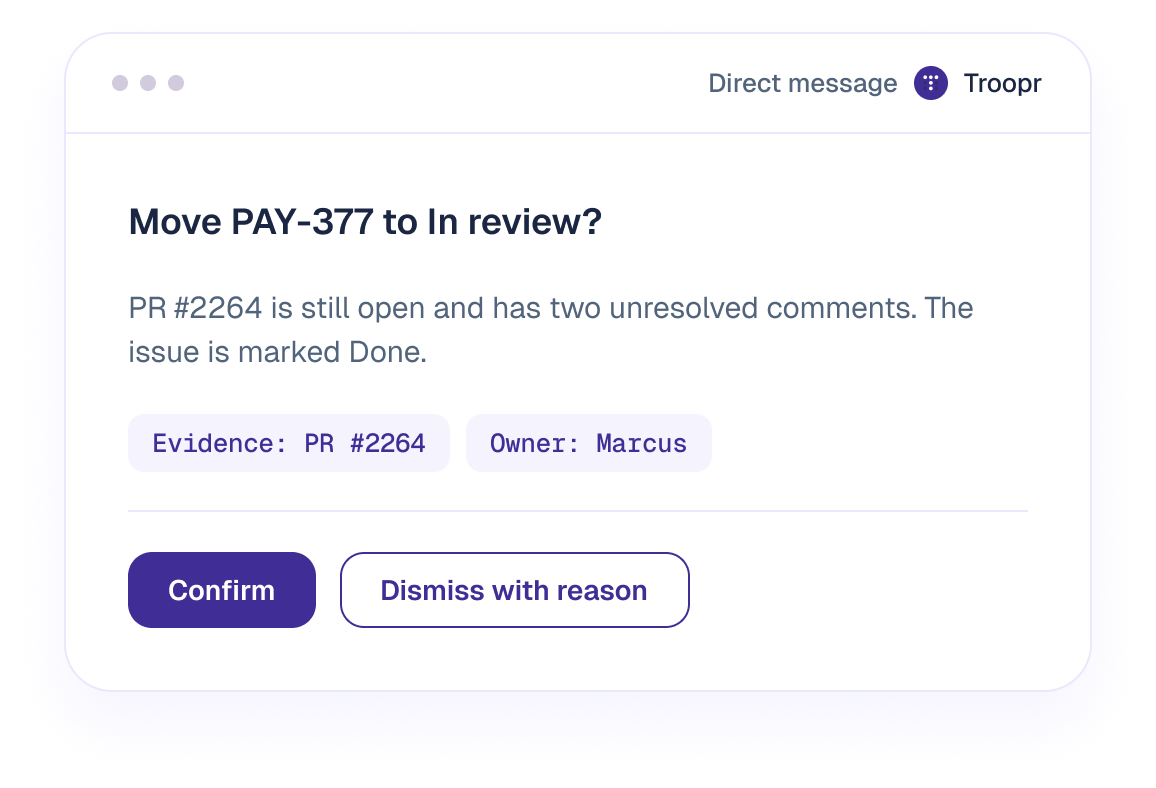
The board stays true without nagging
When work happens and the ticket does not move, Troopr proposes the change to whoever owns it, with the evidence attached. Nothing is written until they confirm, and the write runs in Jira under their own login.
Netflix: 67% less time finding and updating Jira issues
Retrospectives, estimation, and mood, without the calendar invite
Retrospective
Runs async on your format. Action items become Jira issues, with the created key shown on the item.
Planning poker
Up to thirty issues by key, summary, or JQL. The agreed estimate writes back to the issue.
Task check-in
Each person gets their own assigned issues, filtered by sprint, board, or JQL, and updates them inline.
Team mood
The sentiment read, anonymous where the team wants it.
All five check-in types run at each person's own local time and handle holidays, planned absences, and late submissions. All of them are in the free tier.
Tell it what to watch, in a sentence
A routine is one plain-language instruction Troopr runs for the team. No chart pickers, no query editor. Twenty-three templates ship ready, and every one previews exactly what it would send before you turn it on.
A report reads and tells you
It reads the team's Jira and changes nothing in it.
"Post the team's daily read at 9am."
A nudge asks the one person who knows
One person, one question, nothing written.
"Ask whoever owns a ticket in review more than two days whether it is still moving."
A proposal offers the change
It writes under the owner's login once they confirm.
"When a PR is merged and its ticket still says in progress, propose the move."
Any routine can stay silent until its condition is true, so hearing nothing means nothing is wrong.
Ask about the sprint, and correct what it learns
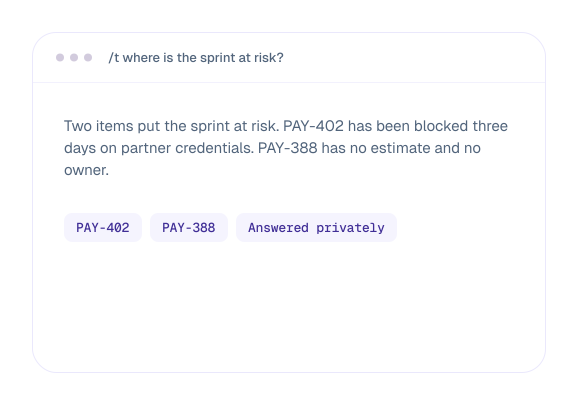
Ask anything about team state
What shipped, who is blocked, where the sprint is at risk. Answers cite the issue keys behind them, and come back to you privately when you ask in a channel.
It learns how your team works
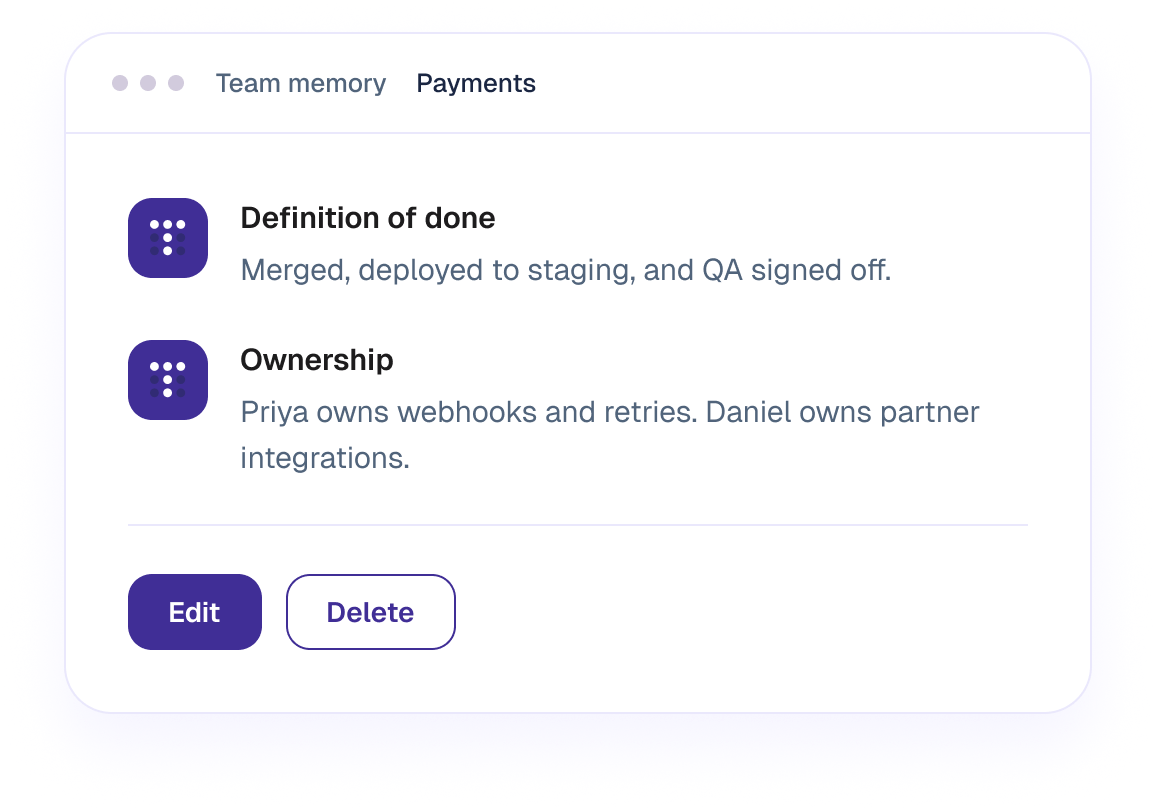
Who owns what, what done means here, your recurring risks. A memory page shows exactly what it holds, and your corrections beat its inference.
Built to clear your security review
The privacy posture is a precondition of the product, not a later add-on. It's what makes an AI-native model safe to put in front of your team and your auditors.



- No training on customer data. Your work never trains a model.
- No storage of raw messages. Troopr derives and persists a structured set of facts about how your team works, not the raw firehose.
- Clear scope. Team channels, connected work tools, and a person's own shared activity. Troopr does not read other people's private DMs.
- OAuth and Jira permissions. Troopr authenticates via OAuth and never bypasses your Jira project, issue, or field permissions.
Real teams, real hours back
Snowflake
86%
Of weekly status-meeting time eliminated with async check-ins.
Netflix
67%
Less time finding and updating Jira issues. Cleared by their internal security team.
Roku
45%
Less context-switching between chat and Jira, around 1.8 focused hours back per engineer per day.
Coralogix
20 min
Returned per person per day from the daily sync.
Free for 10 seats, permanently
$6 per seat/month billed annually, $8 monthly. Everything included. A seat is someone who takes action, so everyone who only reads is free forever.
What engineering leads ask first

No. It takes the mechanical half of the role: running the standup, keeping the board current, surfacing blockers, producing the reports. Coaching, facilitation, and judgement about how the team should work stay with a person.
It reads each person's live activity in the work tracker, the code including the diffs behind vague commit messages, and the team's channels, plus the live standup where you keep one. It holds the team's history and a model of who owns what. Where two sources disagree, it flags the contradiction rather than picking one.
Yes. Jira Cloud, Jira Server, and Jira Data Center, with the same standups, routines, and project sync. Team-managed and company-managed projects, scrum and kanban boards. For instances behind a firewall there are fixed IPs for allowlisting and an agent mode, and Enterprise can run Troopr inside their own network.
Only if you keep a live standup. Troopr announces itself in the meeting chat, listens without speaking, and deletes transcripts after 30 days, keeping only distilled facts. If the team would rather have no presence on the call, the automated standup produces the same grounded report without one.
A person's own answer always beats inference, and every update is editable before or after it posts. Nothing is written to a ticket without someone confirming it, and dismissing a proposal with a reason becomes a working agreement future proposals respect.
Point it at tomorrow's standup
Let it write the report, then judge the report. Free for 10 seats, everything included, no credit card.

The AI project manager for engineering teams. Forms its own view of the work and does the coordination, right where your team already works.
101 Arctic Circle, Round Rock, Texas 78664, United States.