


The async standup
that writes itself
Every other async standup tool asks your team to type the update. Troopr drafts it from the work each person actually did, posts one report at everyone's own local time, and turns what it finds into ticket updates the owner confirms
Free for 10 seats . No credit card required. Runs in Slack & Microsoft Teams
Trusted by 600+ engineering teams worldwide
Async standup fixed the meeting. It did not fix the status.
Moving the standup to writing removes the calendar problem and leaves the harder one untouched. The update is still self-reported, so it is still only as good as what someone remembered to type.
The updates decay
Week one everybody writes three thoughtful lines. By week six it is "same as yesterday." A format nobody reads is worse than a meeting nobody attends.

86% of weekly status-meeting time gone
The board drifts from the channel
The update says the work is nearly done. The ticket has not moved in four days. Async standup writes a second record of the truth instead of correcting the first.

67% less time in Jira
You still assemble the picture
Twelve updates in a channel is not a status. Someone reads all of them and works out what matters before planning and the leadership review.

3.8 hrs/week back for managers
It reads the work, so nobody reports on themselves
The update is drafted before anyone is asked
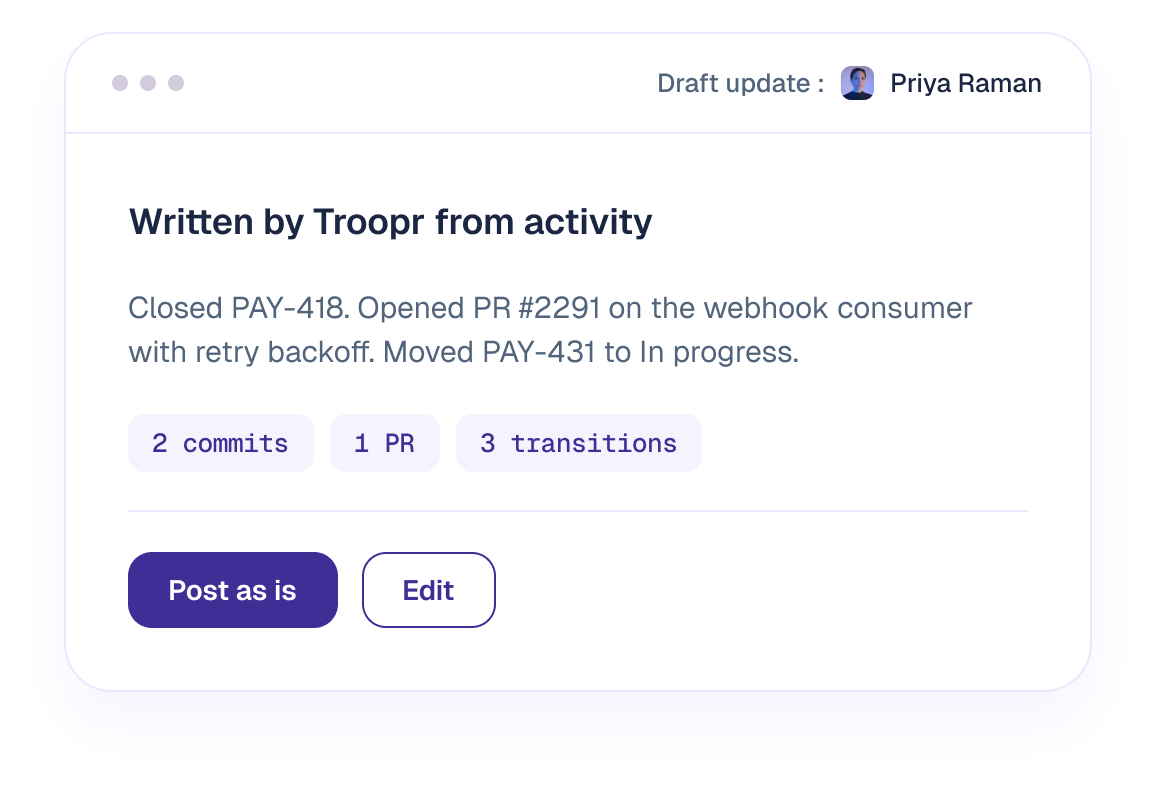
Troopr reads each person's issues, transitions, comments, pull requests and commits, including what the diffs actually changed, so a vague commit message does not hide real work. It asks someone directly only when it genuinely cannot tell. People edit and confirm in one tap, and their own answer always beats what Troopr inferred.
One report, not a scroll
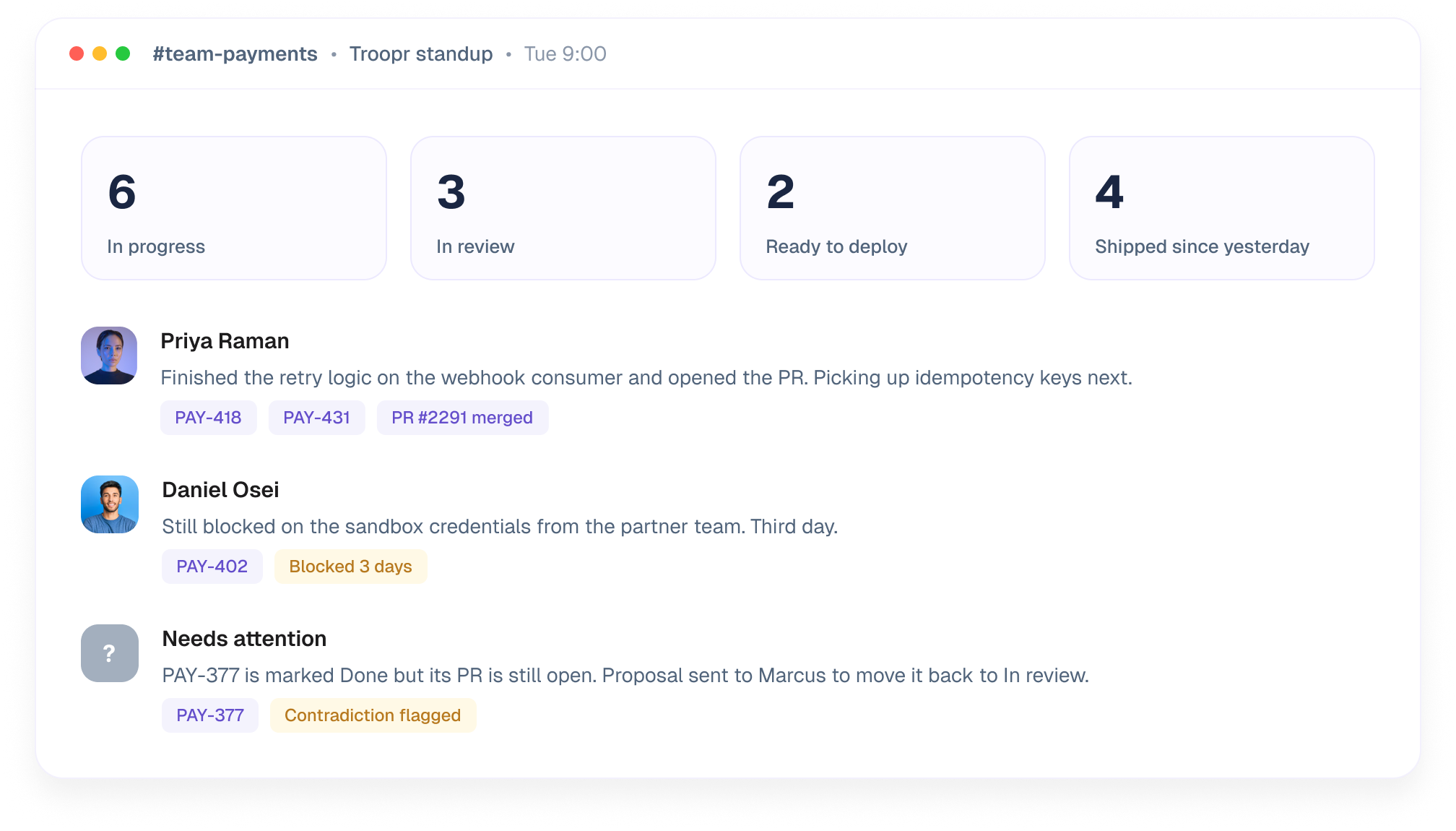
The report opens with a read on the day and a flow line covering in progress, in review, ready to deploy and shipped since yesterday, then a needs-attention section naming specific people and specific items. Blockers, themes and action items are pulled out for you, so nobody reads twelve updates to find the one that matters.
The standup moves the board
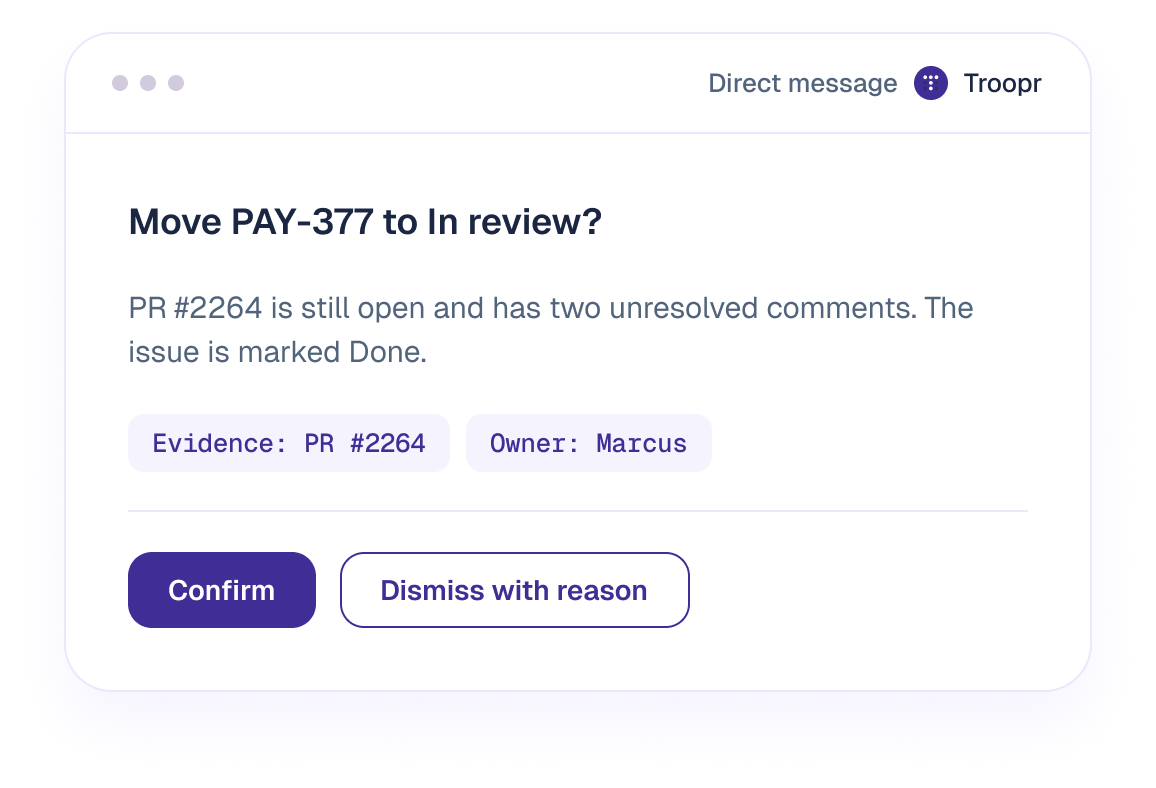
Participants transition and update their own issues from inside the standup thread, and each person's Jira activity attaches to their response. Where work happened and the ticket did not move, Troopr proposes the change to whoever owns it. Nothing is written until they confirm, and the write runs under their own Jira login.
Roku: ~45% less context-switching between chat and Jira
Everyone answers in their own morning
An asynchronous daily standup works the same for Bangalore, Berlin and Denver, without anyone picking a compromise hour.
- Each person prompted at their own local time
- Team and personal holidays, planned absences, bulk upload
- Reminders, late submissions, skip, and answer-ahead
- Anonymous participation where the team wants it
- Cross-team standups over shared channels, one combined report
- Persistent web view, insights and history with PDF export
Keep the live standup on the days it earns its place
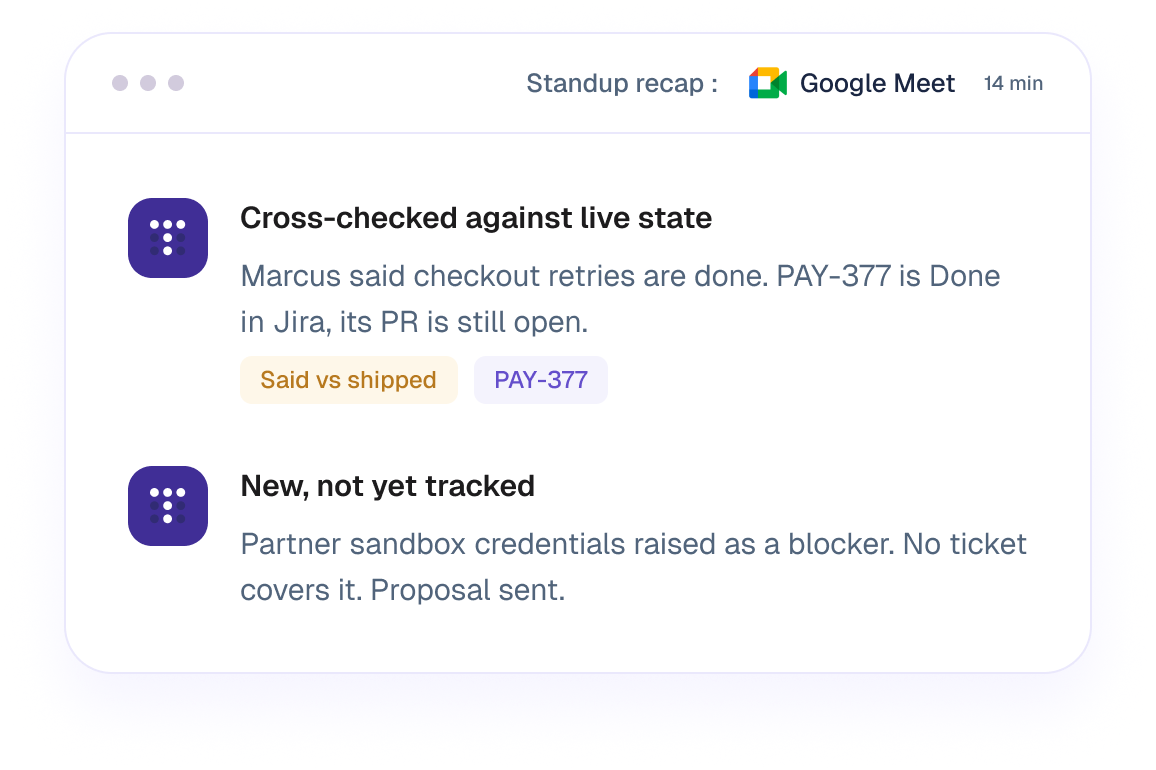
Troopr joins on Google Meet, Zoom or Microsoft Teams, announces itself, listens, and posts the recap. Live and async updates merge into a single report, so mixing modes does not split the record, and the recap flags the ticket called done that is still in review rather than repeating what was said.
Retrospectives, estimation and mood, all async
Retrospective
Runs async on your format. Action items become Jira issues, with the created key shown on the item.
Planning poker
Up to thirty issues by key, summary, or JQL. The agreed estimate writes back to the issue.
Task check-in
Each person gets their own assigned issues, filtered by sprint, board, or JQL, and updates them inline.
Team mood
The sentiment read, anonymous where the team wants it.
All five check-in types run at each person's own local time and handle holidays, planned absences, and late submissions. All of them are in the free tier.
Tell it what to watch, in a sentence
A routine is one plain-language instruction Troopr runs for the team. No chart pickers, no query editor. Twenty-three templates ship ready, and every one previews exactly what it would send before you turn it on.
A report reads and tells you
It reads the team's Jira and changes nothing in it.
"Post the team's daily read at 9am."
A nudge asks the one person who knows
One person, one question, nothing written.
"Ask whoever owns a ticket in review more than two days whether it is still moving."
A proposal offers the change
It writes under the owner's login once they confirm.
"When a PR is merged and its ticket still says in progress, propose the move."
Any routine can stay silent until its condition is true, so hearing nothing means nothing is wrong.
Nothing is written until a person confirms
Every action Troopr can take is typed, from a closed vocabulary, and it goes to the person who owns the work.
- Routed to the owner of the work, with a manager lane for unowned items
- Revalidated against live state at the moment of confirmation
- Executed as that person through their own Jira connection
- SOC 2 Type II, ISO 27001, GDPR, and OAuth that respects Jira permissions
- No training on your data, no raw messages stored, transcripts deleted after 30 days
- Persistent web view, insights and history with PDF export
Real teams, real hours back
Snowflake
~86%
Of weekly status-meeting time eliminated with async check-ins.
Netflix
~82%
Less time spent in status-update meetings across distributed teams.
Roku
~20 min
Returned per person per day from the daily sync.
Coralogix
~3 hrs
Saved per week per PM, with 50+ check-ins running across a fully remote org.
Free for 10 seats, permanently
$6 per seat/month billed annually, $8 monthly. Everything included. A seat is someone who takes action, so everyone who only reads is free forever.
What engineering leads ask first

An asynchronous standup replaces the live daily meeting with written updates each person contributes on their own schedule, usually covering what moved, what is next and what is blocked. A tool collects the responses and compiles them into one report. Troopr goes a step further and drafts each update from the person's real activity before asking them anything.
A question-based bot waits for a typed answer, so the quality of the standup tracks how much time each person felt like spending on it. Troopr reads the work first and writes the draft, then asks only where it genuinely cannot tell. That is the difference between a record of what people reported and a record of what actually happened.
Yes. Jira Cloud, Jira Server, and Jira Data Center, with the same standups, routines, and project sync. Team-managed and company-managed projects, scrum and kanban boards. For instances behind a firewall there are fixed IPs for allowlisting and an agent mode, and Enterprise can run Troopr inside their own network.
Only where Troopr cannot tell, or where they want to add context the tools do not show. Everything else is a one-tap confirm, and their edits always override inference.
Yes. Each participant is prompted at their own local time, with holidays, planned absences, reminders, late submissions and answer-ahead handled. Cross-team standups over shared channels produce one combined report.
Jira Cloud, Jira Server and Jira Data Center, with the same standups, routines and project sync. For instances behind a firewall there are fixed IPs for allowlisting and an agent mode, and Enterprise can run Troopr inside their own network.
Point it at tomorrow's standup
Let it write the report, then judge the report. Free for 10 seats, everything included, no credit card.

The AI project manager for engineering teams. Forms its own view of the work and does the coordination, right where your team already works.
2035 Sunset Lake Road, Suite B-2, Newark, DE 19702, United States.