

What Is Backlog Grooming / Refinement? Definition, Benefits, Process and Best Practices
Backlog grooming is the work that decides whether sprint planning takes forty minutes or three hours. Every other sprint ceremony has a fixed slot on the calendar and a defined output. This one is ongoing, easy to skip, and the first thing to go when a sprint gets tight.
Skipping it is expensive in a way that shows up somewhere else. Planning turns into a session where the team reads tickets for the first time, estimates get invented under time pressure, and work starts on items nobody has agreed the shape of. The cost never appears on the grooming meeting's budget.
This guide covers what backlog grooming is, the process step by step, who owns it, who should be in the room, how to run it in Jira, what AI can and cannot do for it, and the practices that separate a session worth an hour from a meeting that reads a list aloud.
What is backlog grooming / refinement?
Backlog grooming, now officially called backlog refinement, is the ongoing work of getting upcoming backlog items ready to be planned. That means breaking large items into smaller ones, adding enough detail for someone to start, sizing them, and putting them in the right order.
It is not a single meeting, though most teams schedule one. The 2020 Scrum Guide describes refinement as an ongoing activity rather than a formal event, which is why it sits outside the four scrum events. In practice teams run a weekly session and do smaller refinements continuously as questions come up.
The output is a backlog whose top is ready. Not the whole backlog, which is a common and expensive misreading. Ready means roughly one to two sprints of work at the top that the team could start on Monday without another conversation.
The backlog is the single ordered list of everything the team might do, which puts backlog project management underneath sprint planning, forecasting and roadmap conversations alike. When it degrades, all three degrade with it, usually before anyone traces the cause back here.
Backlog grooming vs backlog refinement: why the name changed
They are the same activity. The July 2013 revision of the Scrum Guide swapped the word grooming for refinement and left the surrounding description intact, which is the clearest evidence that nothing about the practice changed.
The reason for the change is practical rather than methodological. Grooming carries an unpleasant secondary meaning in the UK and parts of Europe, and refinement is a more accurate description of the work anyway. Most teams still use both words in conversation, and "backlog grooming" remains what people search for.
Use whichever your team already says. The word is not the part that goes wrong.
Backlog grooming vs sprint planning
Grooming prepares the backlog. Sprint planning commits to a slice of it. Grooming is continuous and looks one to two sprints ahead; planning is a single event at the sprint boundary that produces a sprint goal and a sprint backlog.
The relationship between them is the useful thing to understand. Sprint planning length is almost entirely a function of refinement quality. If the team is writing acceptance criteria during planning, planning will always overrun, and the fix is upstream.
What a groomed backlog looks like: DEEP
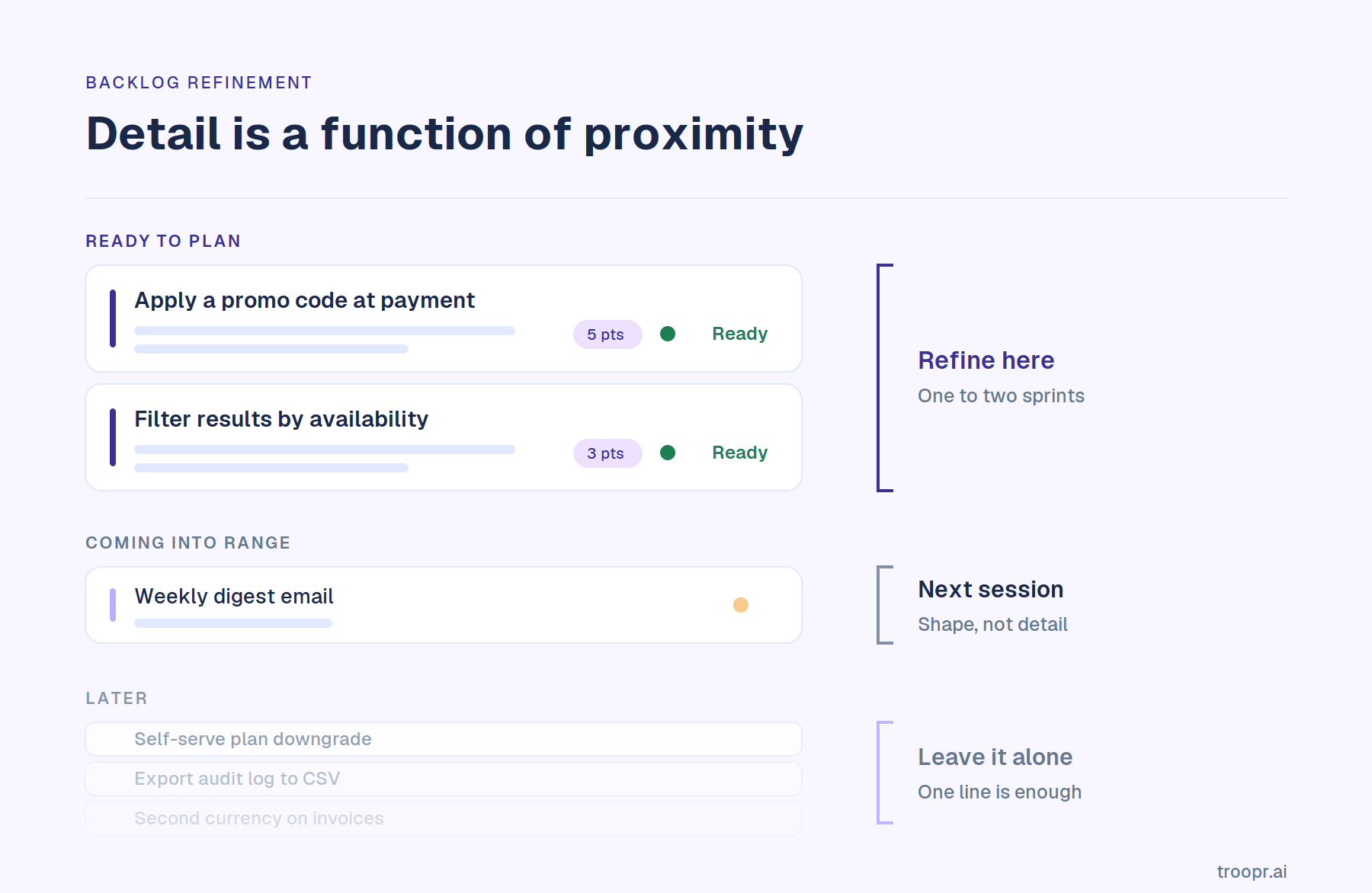
The DEEP model is the most useful shorthand for whether a backlog is in good shape.
- Detailed appropriately. Items near the top carry acceptance criteria and enough context to start. Items further down are one line. Detail is a function of proximity, not of importance.
- Estimated. Everything near the top has a size, even a rough one. The estimate matters less than the conversation that produced it.
- Emergent. The backlog changes constantly as the team learns. A backlog that has not changed in a month is not stable, it is abandoned.
- Prioritized. Ordered, not bucketed. A backlog where forty items are all marked high priority has no order at all.
For individual items, INVEST is the companion check: independent, negotiable, valuable, estimable, small, testable. If an item fails two or more of those, it usually needs splitting rather than more description.
The goal and importance of backlog grooming
The goal is narrow and worth stating plainly: make sure the team never sits down to plan a sprint with items it does not understand.
Everything else follows from that. A refined backlog means planning is a prioritization conversation rather than a comprehension exercise. It means estimates are based on a shared understanding of scope instead of a guess made in the room. It means work starts without a two-day delay while someone chases the product owner for an answer.
The importance is easiest to see in its absence. An ungroomed backlog produces the same five symptoms on every team: planning that overruns, items carried over sprint after sprint, mid-sprint scope discoveries, estimates nobody trusts, and a backlog so large nobody reads past the first screen.
There is a second-order effect that matters more for an engineering team. When the backlog is unreliable, the manager becomes the interface to it. Every question about what is next, what is ready, or what a ticket means routes through one person, which is a bottleneck and a single point of failure.
Benefits of backlog grooming
Sprint planning gets shorter. The most immediate and measurable benefit. Teams that refine properly routinely cut planning from hours to under an hour, because the conversation is about sequencing rather than scope.
Estimates get more reliable. Sizing an item you discussed last week is a different exercise from sizing one you are reading for the first time. Better estimates compound into forecasting the team can defend to leadership.
Fewer surprises mid-sprint. Most scope explosions are discoverable in refinement. The dependency nobody thought about, the API that does not return what the ticket assumes, the design decision still open. Finding those in a grooming session costs a conversation; finding them on day six costs the sprint.
Work is ready when capacity frees up. An engineer who finishes early can pick up the next item without waiting for a decision. Without refinement, spare capacity turns into idle time or into someone starting the wrong thing.
Shared understanding across the team. Refinement is one of the few forums where the whole team discusses upcoming work before anyone is assigned to it. That is where the knowledge silos get broken and where a second person learns enough about a service to review changes to it.
The backlog stays a decision tool rather than a graveyard. Refinement includes deleting things. A backlog with two years of stale items is not a plan, and pretending otherwise costs the team every time someone searches it.
Stakeholders get honest answers. "Is this in the next sprint" is answerable when the top of the backlog is ordered and sized. Otherwise it is a guess with a confident tone.
The backlog grooming process
A working session has five stages. The order matters, because skipping straight to estimation is the most common way a session produces numbers nobody believes.
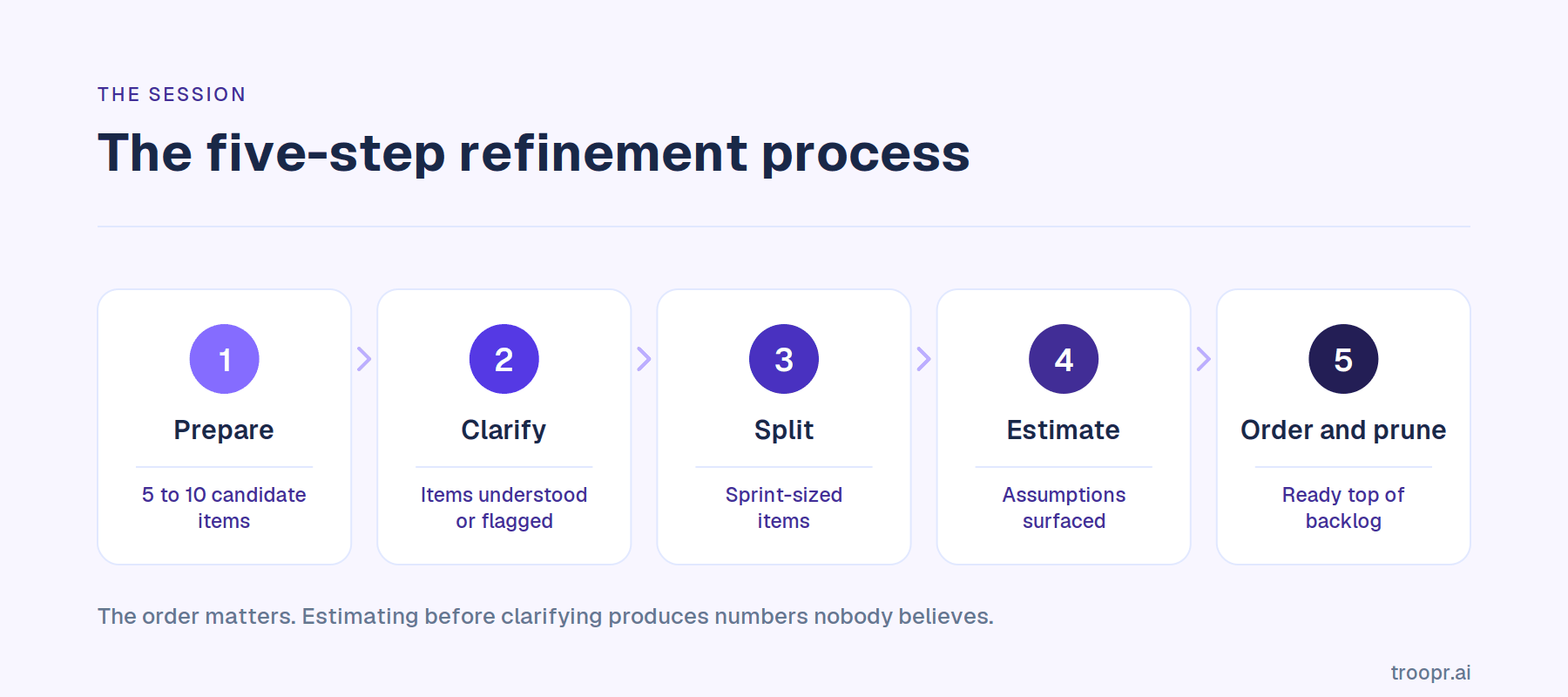
1. Prepare before the session
The product owner arrives with a shortlist: the five to ten items most likely to be planned next, in priority order, each with a first pass at context. Anything that needs an answer from outside the team should already have been asked.
This is the step that decides the quality of everything after it. A session that starts by working out which items to discuss has spent its first fifteen minutes on preparation that should have happened elsewhere.
2. Clarify each item
Walk the shortlist. For each item the team asks what problem it solves, what done looks like, and what is explicitly out of scope. Acceptance criteria get written or sharpened here, by the team rather than for it.
The useful signal is questions nobody can answer. Those items are not ready, and the right outcome is an owner and a follow-up, not a guess.
3. Split what is too big
Anything that cannot finish inside a sprint gets broken down. Common seams: by user journey step, by happy path versus edge cases, by read versus write, by interface versus implementation, by one data source at a time.
Splitting is the highest-value activity in refinement and the one teams do least. A large item is not just slow, it hides risk and makes flow unreadable.
4. Estimate
Size the items the team now understands. The number is secondary; the point is surfacing disagreement. When two engineers give wildly different estimates, the gap is almost always a scope assumption nobody had said out loud, and finding it is the whole value of the exercise.
Techniques vary and any of them work. Planning poker is the most common because the simultaneous reveal stops the loudest voice anchoring the room.
5. Order and prune
The product owner sets the final order, informed by what the team just learned about effort and dependencies. Then delete. Anything nobody has advocated for in six months is noise, and closing it is reversible.
A 60-minute backlog grooming agenda
A working shape for a two-week sprint. Adjust the split, not the sequence.
- Before the session. The product owner prepares the shortlist, adds context and chases any open questions. Output: five to ten candidate items.
- 0 to 5 minutes, review what changed. Led by the product owner. Output: a shared starting point.
- 5 to 30 minutes, clarify the items. Led by the team, writing or sharpening acceptance criteria. Output: items either understood or flagged as not ready.
- 30 to 40 minutes, split what is too large. Led by the team. Output: items that fit inside one sprint.
- 40 to 50 minutes, estimate. Led by the team. Output: sized items, and any scope assumptions surfaced.
- 50 to 60 minutes, order and prune. Led by the product owner. Output: a ready top of backlog and owners for follow-ups.
How often and how long should backlog grooming take?
Once per sprint is the floor. Most teams running two-week sprints hold a weekly session of 45 to 60 minutes, which spreads the load and keeps items fresh.
On the time budget, one number circulates widely and deserves a correction. Earlier versions of the Scrum Guide suggested refinement usually consumes no more than 10% of the development team's capacity. That line was removed in the 2020 revision, which simply calls refinement an ongoing activity and leaves the cadence to the team. Plenty of articles still cite the 10% figure as current guidance. It remains a reasonable ceiling to sanity-check against, but it is not a rule the framework imposes today.
The practical test is not hours spent. It is whether the top one to two sprints of the backlog are ready. If planning keeps overrunning, refine more. If sessions end early with nothing left to discuss, refine less.
Who owns the backlog grooming process?
The product owner owns the backlog and therefore owns refinement. They decide what gets refined, in what order, and they are accountable for the backlog being in a usable state. On teams without a formal product owner, this lands on the product manager or, on infrastructure and platform teams, often the engineering manager.
The team owns the content of the refinement. Only the people doing the work can say what an item involves, where it will get complicated, and how big it is. A product owner who writes acceptance criteria alone and presents them has run a briefing, not a refinement.
The scrum master owns the session working. Timeboxing, keeping the conversation out of solution design, making sure quieter voices are heard, and noticing when the same item has been discussed three weeks running without resolution. On teams without a scrum master this falls to the engineering manager or a rotating facilitator.
The failure mode worth naming: refinement becomes the product owner's solo homework. The backlog ends up full of well-written items the team has never seen, and planning becomes the first time anyone reads them. The ownership split exists to prevent exactly that.
Who should attend backlog grooming sessions?
Required: the product owner, and enough of the team to represent the work. That last part is the important nuance. Refinement does not need everyone.
Rotate the engineers. Three or four people per session, rotating each time, is usually better than the whole team every week. It keeps the conversation productive, spreads context around over time, and returns hours to people who would otherwise sit through discussions of work they will not touch.
Include QA and design where the item needs them. A story with a real interface decision or a nontrivial test strategy should have the relevant person present rather than be refined twice.
Invite subject matter experts as guests for specific items, and let them leave afterwards.
Keep it under about eight people. Above that, participation drops and the session becomes a presentation.
Stakeholders do not attend by default. Refinement involves saying an idea is too expensive, or that a request is unclear. That conversation is harder with the requester in the room. Bring them in deliberately when their item is the one being discussed.
Backlog grooming in Jira
Most engineering teams run refinement against a Jira backlog, and a few habits make the difference between a Jira backlog that supports the session and one that fights it.
Refine the ordered backlog, not a filtered view. The backlog's rank order is the artifact. If your team refines from a board or a saved filter sorted by something else, the priority conversation quietly stops happening.
Use a definition of ready as a status or a label. Teams that mark items ready can see at a glance how many sprints of prepared work they have, which turns "do we need to refine more" into a visible answer instead of a feeling.
Keep the estimate field consistent. Story points or original estimate, one of them, used the same way by everyone. Mixed conventions make velocity and burndown unreadable and are a common cause of a team distrusting its own charts.
Write the decision on the ticket, not in chat. The most common Jira backlog management failure is a refinement decision that lives in a Slack thread and never reaches the issue. Six weeks later the ticket says one thing and the team remembers another. Syncing the thread into the issue's comments removes this whole class of problem.
Sweep for hygiene before the session, not during it. Items with no estimate, no acceptance criteria, no assignee, or no update in ninety days. Pulling that list automatically ahead of the meeting is the difference between refining and auditing. Our guide to the best Jira Slack integration covers the setup this depends on.
AI backlog refinement: what it can and cannot do
AI backlog grooming is a real category now, and it is worth being precise about where it helps, because the marketing around it runs ahead of the reality.
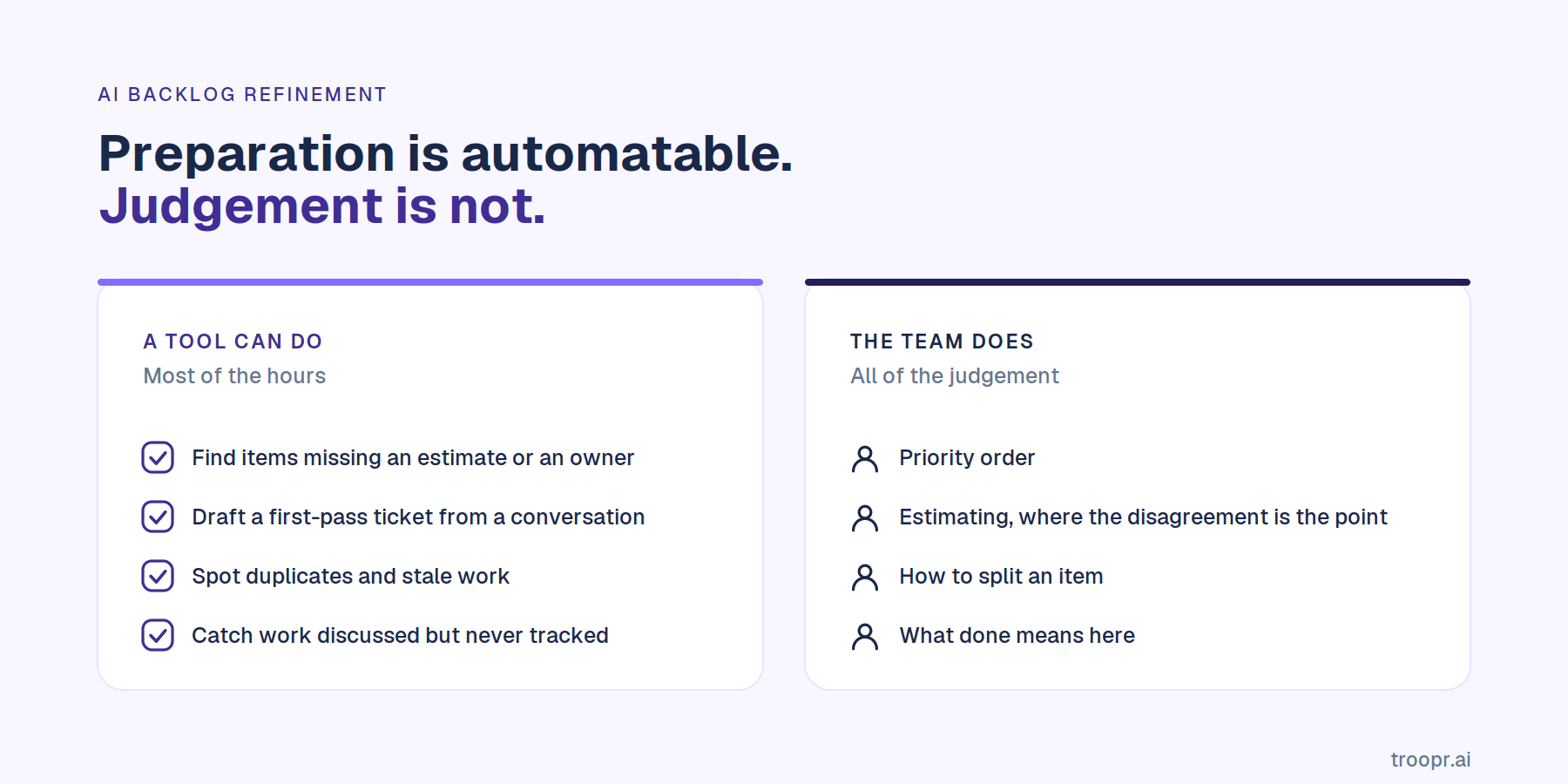
What AI does well today. Finding the items that need attention: no estimate, no recent update, no clear owner, duplicates, items that contradict something already tracked. Drafting a first-pass ticket from a conversation, with a title, description and suggested priority. Answering questions about the backlog in plain language. Spotting that work discussed in a channel has no ticket covering it at all.
What AI does not do. Decide priority. Priority is a judgement about value and risk that depends on context the team holds, and a tool that ranks your backlog for you is either guessing or applying someone else's weighting. Estimation is similar: the value of estimating is the disagreement it exposes between two engineers, and a model producing a number skips the conversation that was the point.
The useful division of labour is that AI does the preparation and the hygiene, and the team does the judgement. That is worth real time, because preparation and hygiene are most of the hours refinement consumes and none of the value it produces.
When evaluating backlog management software on this, ask three questions: can it see activity outside the tracker, does it write anything without a person confirming, and does it work from what actually happened or only from what someone typed.
Best practices for effective backlog grooming
Timebox it and hold the box. A session that regularly overruns is refining too far down the backlog. Cut the shortlist, not the time.
Refine two sprints ahead, no more. Detail written on an item that gets planned four sprints later is detail that will be rewritten. Refining too far ahead feels productive and is waste.
Come prepared or cancel. A refinement session with no shortlist is a meeting that will invent one. Better to cancel and hold it tomorrow.
Define ready, once, as a team. A short shared checklist for what makes an item plannable. It stops every session relitigating the standard.
Split aggressively. If the team debates whether an item fits in a sprint, it does not. Split it.
Do not design the solution. Refinement establishes what and how big, not how. When the conversation turns into architecture, name it and take it offline with the two people who care.
Let anyone flag an item for refinement. Engineers spot unclear tickets earlier than product owners do, because they are the ones who will have to start them.
Delete without ceremony. Closing a stale item is reversible and costs nothing. Carrying it forever costs attention every time someone scrolls past.
Rotate who attends and who facilitates. Spreads context, prevents the session becoming two people's meeting.
Run the preparation async. Questions on items, first-pass sizing and hygiene sweeps do not need a shared hour. Collecting those before the session lets the live time go to the items where people actually disagree, which is the only part that genuinely needs everyone at once.
Common mistakes
Refining the entire backlog instead of the top of it. Treating the session as a status update on in-flight work. Letting the product owner write acceptance criteria alone. Estimating items nobody has clarified. Inviting the whole team every week regardless of the agenda. Allowing the backlog to grow without ever pruning. And skipping refinement in a busy sprint, which guarantees the next planning session is worse.
Manage backlog grooming with Troopr
Most of the hours refinement consumes go on preparation and hygiene: working out which items need attention, chasing missing estimates, noticing that something discussed in a channel was never ticketed. Troopr is the AI project management agent for engineering teams, and it does that work itself.
Troopr reads each person's Jira activity, their pull requests and commits including the code diffs behind them, and the team's Slack channels, then forms its own view of the team's work. It holds a per-team memory of who owns what, what done means using your real Jira status names, and where work repeatedly stalls. The backlog work runs on that.
The hygiene sweep runs before the session, not in it. A routine is a standing instruction in plain English that Troopr runs for the team. Several are built for exactly this: issues missing an estimate, issues missing updates, estimates too high for the sprint, where work is piling up, an overdue sweep, and anything you can express as a JQL query or a saved filter. Reports render in Slack as charts and lists with triage buttons on every issue, so an item can be fixed from the message rather than from a tab.
Stale work surfaces without anyone watching for it. Any routine can run as a watch, which checks on its cadence and speaks only when its condition is true. Issues not updated in N days, an issue count crossing a threshold, anything matching a JQL filter. Silence means nothing needs attention, and the routine's last result still reads "checked, nothing to say" so a quiet watch is visibly working.
Missing estimates get chased without you doing the chasing. A nudge DMs one person about their own work and returns the answer to whoever set the routine. Estimate prompts, stale work checks and in-review follow-ups all run this way. Nothing changes in Jira, and no one is copied into a public reminder.
Work discussed but never tracked gets caught. Troopr raises a proposal for anything raised in a check-in that no ticket covers yet, alongside proposals for unassigned work, missing due dates and assignee fixes. Every proposal is typed, carries its evidence, is revalidated against live Jira state at the moment of confirmation, and runs under the confirming person's own Jira login. No model writes to your backlog on its own.
Tickets get created where the work is discussed. Task It turns any Slack message into a Jira issue with the title, description, priority and suggested assignee filled in, one of thirteen entry points for creating an issue from Slack. Refinement decisions in a thread sync into the issue as comments, as their author, so the ticket carries the reasoning rather than a summary of it.
Estimation runs in chat. Planning poker takes up to thirty issues selected by key, summary or JQL, and writes the agreed estimate and any other field back to Jira when the round closes. It runs async at each participant's local time, as one of five check-in types on a team, so a distributed team sizes work without finding a shared hour.
And you can just ask. Ask Troopr answers plain-language questions on team state in the web app, by Slack DM, or with a slash command in any channel, with the answer returned privately.
Netflix's engineering team reported roughly 67% less time spent finding and updating Jira issues, and cited that Troopr was cleared by their internal security team as a deciding factor. Wellthy Therapeutics moved its ceremonies async and reports better Jira hygiene alongside more efficient scrum ceremonies. Instabase and Celink both run Jira hygiene this way, and Creditas runs async planning poker with its distributed product and engineering teams.
Refinement, estimation, standups, retros and Jira issue management run in one app in Slack, on every plan including Free.
Conclusion
Backlog grooming is not a meeting you should try to make more efficient. It is preparation for every other decision the team makes, and the reason it feels expensive is that most of the hour goes on assembling facts rather than making calls.
Take the assembly off the team and the session becomes what it was meant to be: a short conversation about the handful of items where people genuinely disagree. That is the part worth everyone's time, and it is the part that never gets enough of it.
Start for Free. Ten seats, three synced channels, three routines, every feature, no credit card. Put a hygiene sweep on your backlog and see what it finds before your next refinement session. $6 per seat per month when your team outgrows the free tier, and only people who take action count as seats.
Start for Free or Book a Demo to see it run against your own Jira project first.
Backlog grooming: frequently asked questions
What is the difference between backlog grooming and backlog refinement?
Nothing. They are the same activity under two names. The July 2013 revision of the Scrum Guide replaced the word grooming with refinement and left the surrounding description unchanged. The rename happened partly because grooming has an unpleasant secondary meaning in the UK and parts of Europe, and partly because refinement describes the work more accurately. Most teams use both terms in conversation.
Who leads backlog grooming?
The product owner, since they own the backlog and its order. The team supplies the content, because only the people doing the work can say what an item involves and how big it is. The scrum master, or an engineering manager where there is no scrum master, keeps the session inside its timebox and stops it turning into solution design.
How often should backlog grooming happen?
At least once per sprint, and most teams on a two-week sprint find a weekly 45 to 60 minute session works best. The real test is not hours spent but whether the top one to two sprints of the backlog are ready to plan. If sprint planning keeps overrunning, refine more often. If sessions end early with nothing to discuss, refine less.
Is backlog refinement limited to 10% of team capacity?
Not any more, though you will see the figure cited constantly. Earlier versions of the Scrum Guide suggested refinement usually consumes no more than 10% of the development team's capacity, and that line was removed in the 2020 revision, which describes refinement as an ongoing activity and leaves the cadence to the team. It is still a sensible ceiling to check yourself against, but it is not a rule the framework imposes today.
Is backlog grooming a scrum ceremony?
Not formally. The Scrum Guide defines four events inside the sprint, plus the sprint itself as a container, and describes backlog refinement as an ongoing activity rather than an event. In practice almost every team schedules it, so most ceremony guides count it as a fifth. Both descriptions are correct depending on whether you are quoting the framework or reading a calendar.
Who should attend a backlog grooming session?
The product owner plus enough engineers to represent the work, usually three or four rotating each session rather than the whole team every week. Add QA or design when an item needs them, and bring subject matter experts in as guests for specific items. Keep it under about eight people. Stakeholders do not attend by default, because refinement involves saying an idea is too expensive.
How far ahead should you refine the backlog?
One to two sprints of ready work at the top is the usual target. Refining further ahead is one of the most common wastes in the practice, because detail written on an item planned four sprints later almost always has to be rewritten. Items deep in the backlog should stay one line until they come into range.
What tools help with backlog grooming?
A tracker you actually order, a way to estimate together, and something that surfaces hygiene problems before the session rather than during it. The gap on most teams is the third one: items with no estimate, no recent update or no ticket at all are found by someone manually scanning the board. Automating that sweep, and running estimation where the team already talks, returns most of the hour to the conversation that needs it. If you are comparing estimation tools, we have a breakdown of online planning poker tools.
Can AI do backlog refinement?
Parts of it. AI is good at finding items that need attention, drafting a first-pass ticket from a conversation, spotting duplicates, and noticing that something discussed in chat was never tracked. It should not set your priority order, which depends on value and risk judgements the team holds, and it should not replace estimation, since the value of estimating is the disagreement it exposes rather than the number it produces. Treat AI as the preparation and hygiene layer, and keep the judgement with the team.
Can backlog grooming be done asynchronously?
The preparation can and should be, particularly on distributed teams. Questions on items, hygiene sweeps and first-pass sizing all work async, and running estimation async at each person's local time removes the timezone tax entirely. Keep a shorter live session for the items where people genuinely disagree, since that conversation is faster in real time.


The AI project manager for engineering teams. Forms its own view of the work and does the coordination, right where your team already works.
101 Arctic Circle, Round Rock, Texas 78664, United States.