

Distributed Team Management Metrics: Slack + Jira Visibility Framework
TL;DR
- Distributed team management now depends on visibility, not presence.
- Traditional “face time” has been replaced by data-led metrics that capture velocity, ownership, and responsiveness.
- Slack and Jira together form the backbone of operational visibility, if instrumented correctly.
- Troopr automates this integration: updates, reports, and alerts flow seamlessly without added meetings.
- With clear SLAs, automated check-ins, and predictive metrics, leaders can manage distributed teams by outcome, not activity.
What You’ll Learn
- How to define a Visibility SLA, a shared expectations for responsiveness and ownership across time zones.
- How to instrument Slack and Jira to create a transparent, measurable workflow without micromanagement.
- How to replace three recurring meetings with two automated reports that keep stakeholders aligned asynchronously.
- Which metrics predict trouble early, before missed deadlines or burnout occur.
- How to build a continuous improvement loop where retros and audits run on live data, not memory.
- Benchmarks from recent research on hybrid productivity and engagement (MIT Sloan).
How distributed teams at scale (like Nextdoor and Roku) use Troopr to operationalize hybrid work visibility.
Intro
Distributed team management has shifted from watching hours to measuring progress. In hybrid and remote environments, productivity isn’t visible through attendance, it’s reflected in metrics that reveal responsiveness, throughput, and alignment. The challenge is surfacing these signals without adding manual reporting overhead or endless meetings.
That’s where the Slack–Jira ecosystem, powered by Troopr, comes in. It transforms everyday conversations into measurable work signals, turning standups, sprint updates, and SLAs into automated visibility loops. This guide walks through practical frameworks to help engineering and IT leaders manage distributed teams through data, not guesswork.
The Visibility SLA
Visibility in distributed teams isn’t about tracking activity; it’s about defining clarity and accountability boundaries that everyone understands. A Visibility SLA formalizes when updates are expected, who owns follow-ups, and how quickly responses should occur across time zones.
It transforms ambiguous expectations like “reply soon” into measurable commitments, just as technical SLAs govern uptime and performance.
Severity-Based Expectations for Issues and Incidents
Distributed engineering and IT teams often struggle with delayed responses simply because urgency isn’t visible.
Once the SLA table is agreed, Troopr can automate compliance directly in Slack:
- Tag the right channel based on issue priority from Jira.
- Auto-remind owners when SLA response windows approach expiry.
By shifting accountability from “who remembered to reply” to “what the system enforces,” managers gain predictable, data-driven response patterns, without chasing updates manually.
Instrumentation in Slack + Jira
A well-instrumented hybrid workflow replaces supervision with signals. Every critical action, from ticket creation to code review, should automatically generate visibility data accessible to everyone.
Troopr bridges this by turning Slack into a real-time telemetry layer for Jira.
Daily Check-ins (Engineers) and Queue Digests (IT)
Troopr Check-ins automate asynchronous standups: each team member answers custom prompts in Slack:
- “What did you complete yesterday?”
- “What’s next?”
- “Any blockers?”
Responses pull live Jira context, so updates link directly to issues and progress reports. For IT teams, Troopr sends queue digests (open tickets, pending approvals, SLA breaches) directly into the channel, eliminating the need for dashboard logins.
💡 Tip: For distributed teams spanning 5+ time zones, schedule Troopr Check-ins at overlapping hours (e.g., 10 AM GMT) to ensure context sharing without synchronous meetings.
Sprint/Incident Dashboards Posted to Channels
Troopr Routines automatically publish sprint summaries and issue trends into Slack. Instead of leaders opening Jira dashboards, the data comes to them, maintaining visibility without creating tool fatigue.
Auto-Nudge Rules for Stale PRs and Blockers
One of the biggest drains in distributed management is invisible stagnation, pull requests waiting days for review or unresolved blockers.
This turns invisible bottlenecks into actionable nudges, letting teams fix flow issues before they affect sprint velocity.
Replace Three Meetings with Two Reports
The fastest way to reclaim time in a distributed setup isn’t by working faster, it’s by removing redundant meetings. Most teams still run three recurring sessions that overlap in purpose: standups, status reviews, and stakeholder syncs. With proper instrumentation, you can replace all three with two automated reports.
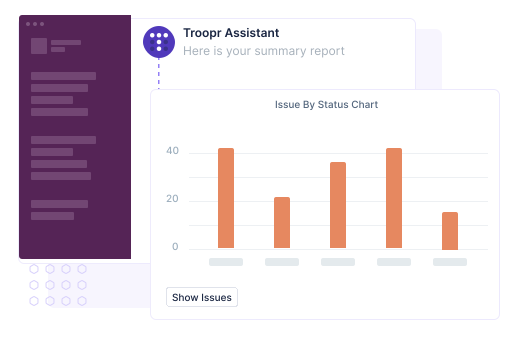
Standup, Status, Stakeholder Sync → Async Reports
Distributed teams lose momentum when every update depends on a calendar slot. Instead, Troopr replaces the three-meeting cadence with asynchronous visibility:
- Daily Standup → Troopr Check-in Report
Each member posts updates via Slack prompts that pull data from Jira, visible in one thread for all.- Captures progress and blockers without waiting for a meeting.
- Time zone–agnostic: everyone contributes when online.
- Weekly Status → Troopr Sprint Summary Report
A visual summary of sprint burndown, velocity, and blockers auto-posts in #project-updates.- Enables management to review project status without dashboard logins.
- Links to underlying Jira issues for direct action.
- Stakeholder Sync → Troopr SLA Dashboard
Stakeholders often join to confirm “how we’re doing.” Automated SLA dashboards give them those answers — response times, reopen rates, and throughput — without a call.
This async rhythm doesn’t eliminate meetings entirely but reserves them for decisions, not updates.
Exceptions: When to Meet Live
Even well-automated distributed teams need live sessions for:
- Critical incidents: where synchronous coordination is faster than async discussion.
- Retrospectives: where qualitative insights complement metrics.
- New sprint kickoffs: when priorities shift or context changes drastically.
The goal isn’t to remove all human contact; it’s to reclaim it for strategic collaboration.
Metrics That Predict Trouble
Most teams monitor lagging indicators, missed deadlines, SLA breaches, or dropped PRs. But distributed management demands leading indicators that surface trouble early, while it’s still fixable.
PR Cycle Time, Reopen Rate, Ticket Aging, Response Latency
These four metrics, tracked automatically through Slack + Jira, reveal where distributed coordination breaks down:
Troopr automates the measurement of all four. Dashboards update in Slack, allowing leaders to spot outliers (e.g., “3 PRs >72 hours”) and trigger auto nudges.
Team Health: Load, After-Hours Pings, Meeting Time
Performance metrics alone aren’t enough, sustainable distributed teams balance output and well-being.
- Workload Distribution: Uneven issue ownership signals risk of burnout.
- After-Hours Activity: Frequent Slack or Jira updates beyond local work hours indicate overload.
- Meeting Time Ratio: Time spent in meetings vs. async work shows operational efficiency.
Troopr’s Check-ins and Reports make these visible, letting managers adjust staffing, redistribute load, or shorten cycles before fatigue becomes failure.
Continuous Improvement Loop
Distributed visibility isn’t a one-time setup, it’s a living system that improves with iteration.
Once metrics are visible in Slack, leaders can evolve processes based on what the data reveals rather than on anecdotal feedback.
Retro Prompts Pulled from Live Metrics
Retrospectives are most valuable when grounded in facts.
Troopr automatically pulls recent metrics into retro check-ins, so teams discuss data points rather than perceptions:
- “Which blockers delayed this sprint most?” → Linked to issue tags and PR delays.
- “Where did response times exceed SLA targets?” → Pulled from incident logs.
- “What patterns appear in reopen rates or aging tickets?” → Pulled from Jira metrics.
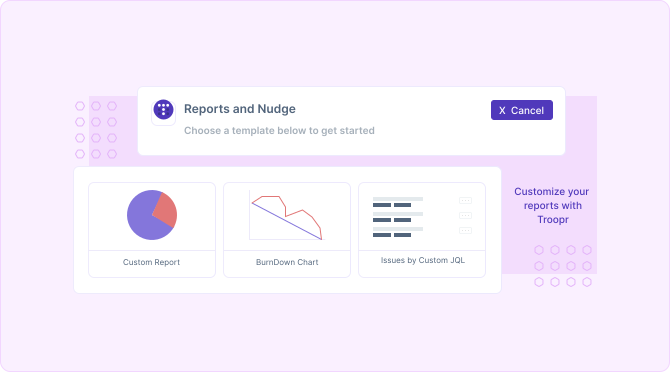
Instead of spending 20 minutes collecting information, teams start with insights already surfaced in Slack.
This closes the feedback loop, every retro feeds into a measurable improvement for the next cycle.
Quarterly Audit of Channels, Bots, and Scopes
Over time, distributed workspaces accumulate noise, inactive channels, redundant bots, or outdated automations that dilute visibility.
Establish a quarterly visibility audit:
Step 1: Export Troopr and Jira integration usage logs.
Step 2: Identify dormant channels with <5% activity.
Step 3: Review each automation rule — is it still valuable?
Step 4: Retire, merge, or reconfigure as needed.
Step 5: Update security scopes and verify SSO permissions.
Governance Tip: With Troopr’s enterprise controls (SOC 2 Type II, SSO, audit logs), teams can perform these audits safely, ensuring compliance while optimizing performance.
This continuous improvement loop transforms distributed management into a measurable, self-correcting system — transparent, accountable, and adaptive.
Proof & Benchmarks
The proof is clear: when visibility improves, distributed teams perform better.
A recent MIT study, “Seven Truths About Hybrid Work and Productivity”, found that:
- Teams with transparent communication rhythms saw over 50% fewer coordination delays.
- Employees with clear expectations for responsiveness reported higher engagement and trust.
- Visibility metrics (like project velocity and ticket aging) strongly correlated with sustained hybrid productivity.
For Troopr customers, the same trends appear in practice:
- Creditas unified its hybrid engineering teams across Slack and Jira, automating Scrum rituals. Result: faster delivery and accurate sprint visibility across time zones.
- Wakefit integrated customer-ticket flows from Jira into Slack, eliminating manual copy-paste tasks. The IT team now resolves tickets 30% faster with fewer escalations.
Visibility isn’t just a management preference, it’s a performance multiplier.
By making progress, load, and health visible, leaders manage distributed teams by outcomes, not assumptions.
Further Reading: Hybrid Work Policy for 2025: Principles, Templates & Governance
Conclusion: 5-Item Action Checklist
- Define your Visibility SLA — align response times, ownership, and urgency levels.
- Instrument Slack + Jira via Troopr — automate reports, check-ins, and dashboards.
- Replace redundant meetings with async reporting loops.
- Track leading metrics: cycle time, reopen rate, and team health.
- Run quarterly audits and retros to evolve your distributed visibility stack.
FAQ
Q1. What is distributed team management?
Distributed team management is the coordination of teams that work across different locations and time zones using digital tools for communication, visibility, and accountability.
Q2. How do Slack and Jira improve distributed team visibility?
By integrating communication (Slack) and execution (Jira), teams can centralize updates, track metrics automatically, and avoid information silos.
Q3. What are the best metrics to monitor for distributed teams?
Leading indicators like PR cycle time, ticket aging, reopen rate, and response latency predict bottlenecks before they escalate.
Q4. How can automation reduce meeting load?
Automation tools like Troopr post progress reports, sprint summaries, and SLA dashboards in Slack, replacing routine meetings with actionable updates.
Q5. What governance practices ensure visibility remains secure?
Regular audits, SSO enforcement, and Troopr’s SOC 2 Type II compliance keep distributed operations both transparent and enterprise-grade secure.
Q6. What’s the difference between remote and distributed team management?
Remote often refers to individuals working from home; distributed describes teams intentionally structured across multiple locations or time zones.
More: Remote-First vs Hybrid
Q7. How often should visibility audits be done?
Quarterly reviews of channels, automations, and permissions help maintain focus and compliance without disrupting productivity.


The AI project manager for engineering teams. Forms its own view of the work and does the coordination, right where your team already works.
101 Arctic Circle, Round Rock, Texas 78664, United States.