

Introducing the AI Project Manager for Engineering Teams
Something is changing in how engineering teams produce work. AI agents are joining teams as real contributors. They write code, open pull requests, close tickets. A team of eight can now put out the work of a team of twenty, and the gap is widening every quarter.
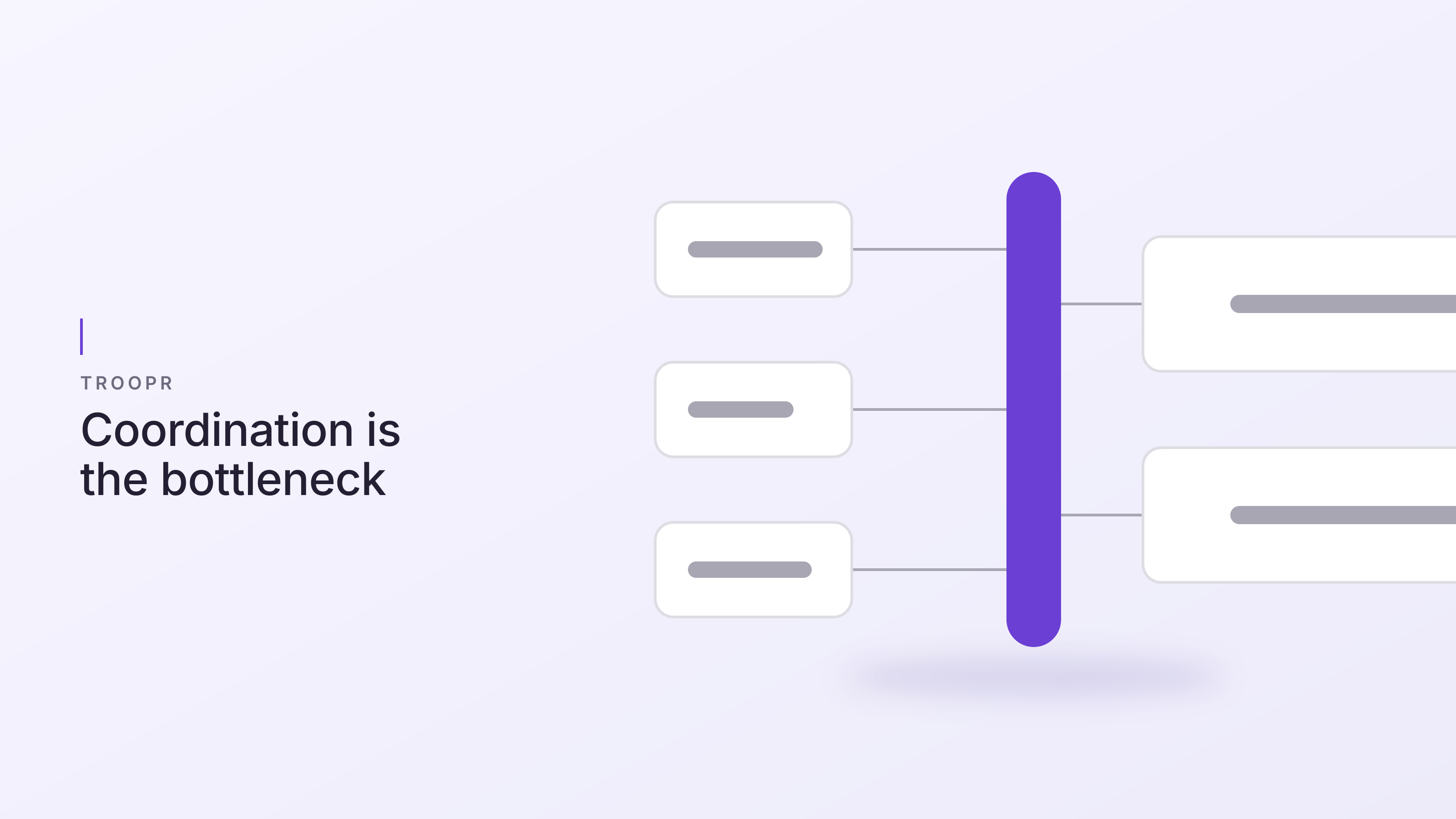
But here is the part nobody budgets for: every contributor, human or agent, adds coordination cost. More work in flight. More threads to follow. More state that somebody has to hold in their head. As output multiplies, the constraint quietly moves. The bottleneck is no longer producing the work. It is knowing what is happening.
Most teams still pay this coordination tax the way they did ten years ago. A daily meeting that exists mostly to find out what is going on. A Jira board that drifts out of date the moment people get busy. A manager who spends mornings reconciling what Slack says against what the board says against what actually merged in GitHub.
The last decade's answer was to record the meeting. That was enough in the old world, when the meeting was where most of the truth lived. It is not enough now. A recording tells you what was said. It cannot tell you whether what was said matches what actually happened, and it cannot connect today's update to the blocker someone mentioned last Tuesday that never got an owner. Coordination has to become AI-native. And it has to have memory.
Troopr, now the AI project manager
Today we are introducing the new Troopr: the AI project manager for engineering teams.
If you have used Troopr over the years, you knew it as the product that connected Slack and Jira and ran your team's check-ins. More than 600 engineering teams run on that foundation, including teams at Netflix, Snowflake, Roku, and Yahoo. It did its job well. But it still waited for people to tell it what was happening. The intelligence lived in the people feeding it.
That has now inverted. Troopr reads the same signals a good manager reads, across Jira, GitHub, Slack, and the standup itself. It forms its own view of what is actually going on, and it does the coordinating. You are no longer keeping Troopr informed. Troopr keeps you informed.
What that looks like this week
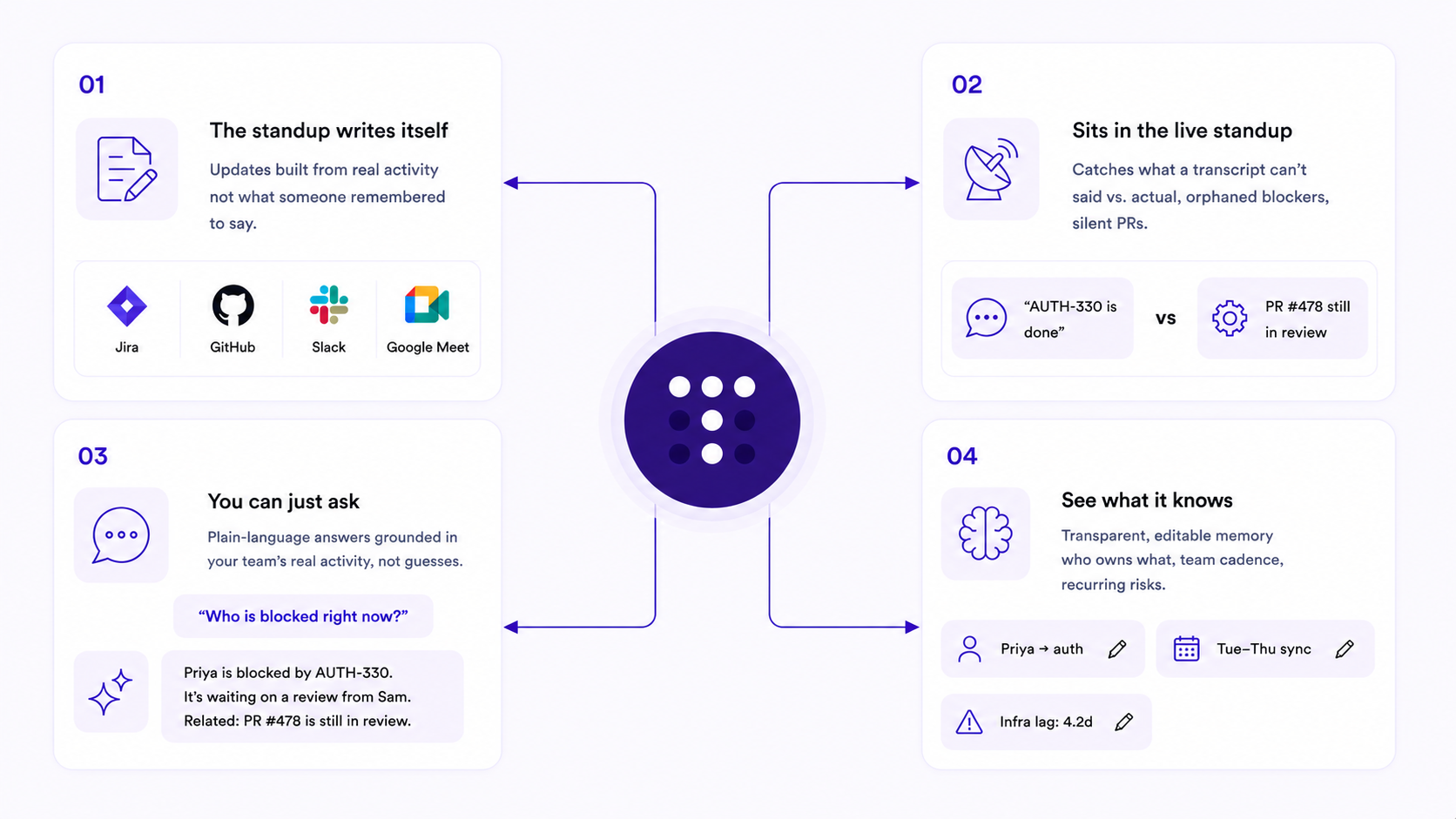
The standup writes itself. Troopr writes each person's update from their own Jira, GitHub, and Slack activity, and asks someone directly only when it genuinely cannot tell what they are working on. For most people, on most days, the ritual of reporting on yourself disappears. What remains is a report of what actually happened, not a paraphrase of what someone remembered to say.
Troopr sits in the live standup. For teams that kept the ritual, Troopr joins the live standup call on Google Meet, Zoom, Teams, and listens & afterward produces one report grounded in the team's history and live Jira and GitHub state. That grounding is what lets it catch things a transcript never could: the ticket someone said was done that is still in review, the blocker from last Tuesday that never got an owner, the PR nobody brought up. A meeting tool only has the one call. Troopr has the team.
You can just ask. Anyone on the team can ask Troopr, in plain language, what shipped this week, who is blocked right now, or where the biggest risks are, and get an answer grounded in the team's real activity rather than a generic guess.
And you can see what it knows. Troopr builds a memory of how your specific team works: who owns what, what "done" means here, the team's cadence, the risks that keep recurring. That memory is not a black box. You can see exactly what Troopr knows about your team, correct it, and delete it. Your corrections always win over what it inferred.
Built to be trusted
Reading across a team's work is a real thing to ask, and we treat it that way. Troopr reads your team's channels and connected work tools, and a person's own shared activity. It never reads anyone else's private messages. It does not train on your data, and it does not store your raw messages; it keeps only the structured understanding described above, the way a human manager remembers a team in impressions and specifics rather than transcripts.
When Troopr proposes a change to Jira, the person whose work it concerns confirms it before anything is written. Nothing happens silently on your behalf. And Troopr is SOC 2 Type II compliant, ISO 27001 certified, and GDPR compliant, which is part of why teams inside some of the most demanding engineering organizations in the world are comfortable running it.
It compounds
Because the memory is per-team, Troopr's read of your team a month in is sharper than its read on day one. It is still useful on day one, because setup includes a quick look back over your recent history. From there, every standup makes the next one more accurate.
The results from teams already on Troopr point the same direction. Netflix reports 90% of the time it used to spend in status update meetings and in finding and updating Jira issues saved. Snowflake reports the same 90% on weekly status meetings. Yahoo saves managers about four hours a week, and each person about thirty minutes a day. Roku saw a 70% productivity gain from eliminating context switching. The common thread is not a better bot. It is that these teams stopped needing meetings just to find out what is going on.
Where this goes
Agents will keep multiplying what teams can produce. Coordination has to keep pace, and we think the only way it does is a coordinator that reads everything, remembers everything, and earns more of the job over time. That is the project manager we are building, always with your team in control.
Try it
Troopr is Slack-first and free to start, with every capability included on the free plan for up to 10 seats. Connecting Jira and GitHub takes a few minutes, and the first standup it writes is the fastest way to judge it.
Explore our products:
Troopr Projects (Manage jira software issues in Slack)
Troopr Routines (Standing instructions Troopr runs for your team)
Troopr Check-ins (Conduct asynchronous meetings in Slack)
Ask Troopr (Get answers grounded in your team's real work)
How it thinks (See how Troopr forms its own view)
if you would like a walkthrough first, Start for Free or Book a Demo.


The AI project manager for engineering teams. Forms its own view of the work and does the coordination, right where your team already works.
101 Arctic Circle, Round Rock, Texas 78664, United States.