

Will AI Replace Scrum Masters?
No. But that answer is less reassuring than it sounds, because scrum master roles are being cut, and the people losing them are understandably not comforted by the distinction between "AI replaced me" and "my role was absorbed.
Both things are true at once. AI cannot do the part of the job that matters most, and plenty of organisations are eliminating the title anyway. Those are separate forces, and confusing them leads people to prepare for the wrong one.
This guide separates them. What is actually happening to the role, what AI can and cannot do, why the roles being cut are being cut, and what makes someone hard to replace.
The short answer
AI will not replace scrum masters, because the core of the role is not automatable. Coaching, facilitation, reading a team's dynamics and owning accountability for its effectiveness are judgement work with no data input that substitutes for them.
What AI does replace is a layer of administration that had accumulated around the role: collecting status, writing updates, chasing stale tickets, assembling reports, preparing ceremonies so they are worth holding.
The risk is not that AI takes the role. It is that if administration was most of what your role visibly produced, the automation of that layer removes the argument for the headcount. That is a positioning problem, and it is solvable.
What is actually happening to the scrum master role
Before the explanations, a warning about the numbers, because this is one of the least trustworthy data environments on the open web.
Search this question and you will find confident claims that scrum master roles are growing by around 24%. That figure circulates widely, is rarely sourced, and appears mostly on sites that sell scrum certifications. You will also find claims of sharp collapse, including a reported 62% fall in UK postings over two years, which turns out to rest on a sample moving from 79 postings to 30. That is a small enough base that the percentage is close to meaningless.
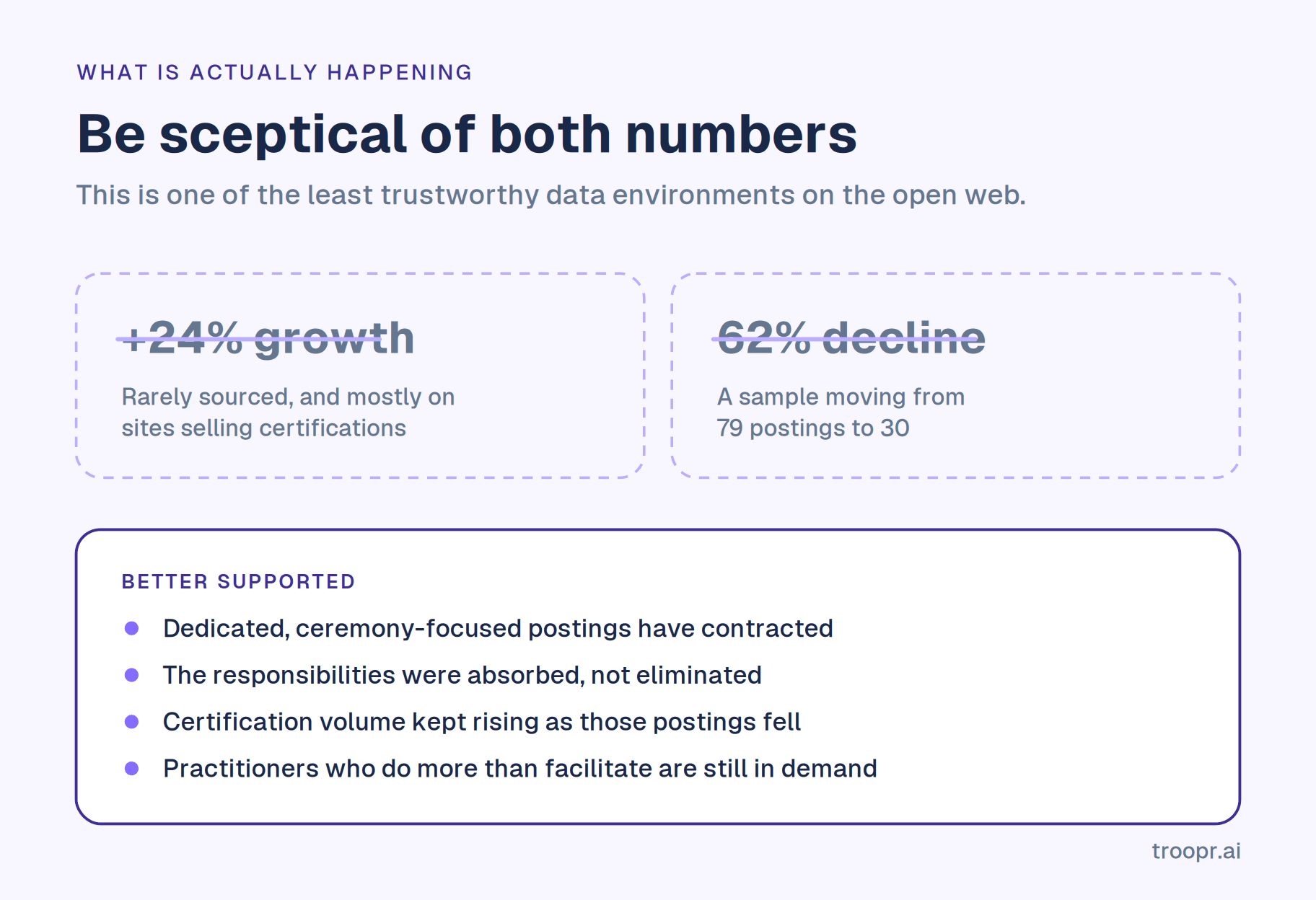
Treat both ends with suspicion. What is better supported, and consistent across practitioner accounts, training providers and hiring commentary, is narrower and more useful:
Dedicated, ceremony-focused scrum master postings have contracted. This is the clearest signal, and it predates any AI tooling capable of doing the work.
The responsibilities have not disappeared. They have been absorbed. Into engineering managers, delivery managers, technical program managers and tech leads. Someone is still running the ceremonies; they just have a different title and other duties.
Certification volume kept rising while dedicated postings fell. More supply chasing fewer dedicated roles, which is most of why the entry level feels brutal right now.
Experienced practitioners who do more than facilitate are still in demand. The contraction is concentrated at the process-only end.
If you want one sentence: the title is becoming something you do rather than something you are.
AI is not the main reason those roles were cut
This matters, because the remedy depends on the cause.
The contraction in dedicated agile roles started well before AI tooling could produce a usable standup. It tracked the end of zero-interest-rate hiring, a broad shift toward flatter structures and fewer non-engineering roles per team, and a specific scepticism about roles whose output leadership could not connect to shipped software.
AI arrived after that argument was already being lost in a lot of companies. What it did was remove the last defensible version of the administrative case. When a manager can get an accurate daily picture of the team without anyone collecting it, "I keep everyone informed" stops working as a justification for a role.
So the honest framing is not that AI is coming for scrum masters. It is that AI removed the floor under a version of the job that was already under pressure.
What AI can genuinely do today
Being precise about this is more useful than reassurance. These are capabilities that ship today, not projections.
Produce the daily standup. A tool reading the tracker and the code host can draft each person's update from what actually happened and ask a person only where it cannot tell. This is the clearest case, and on distributed teams the async standup is already standard.
Catch contradictions. The ticket marked done that is still in review, the pull request nobody mentioned, the blocker with no owner. Cross-checking what was said against what the systems show is something software does better than a human scanning every morning.
Keep the tracker current. Not by writing on its own, in any tool worth buying, but by drafting the correction and routing it to whoever owns the work.
Assemble the ceremonies. Pulling the facts a retrospective or a refinement session needs before it starts, which is where a third of those meetings currently goes.
Report. Burndown, velocity, what shipped, what is at risk, delivered on a schedule without anyone building a slide.
Answer questions about team state. Which removes the most quietly damaging part of the job, being the only reliable way for anyone to find out what is happening.
Add those up and it is a real portion of a working week. If that portion is what your role is known for, the exposure is genuine and worth taking seriously.
What AI cannot do
Coach a person. Helping an engineer who has stopped speaking up, or a product owner who overcommits every sprint, requires a relationship and a read on what someone can hear that week. There is no input that gets a model there.
Create psychological safety. A retrospective works because people believe candour is safe. That belief is built by a person behaving consistently over months. A tool can run the format; it cannot make the room honest.
Read what is unsaid. Hesitation in an answer, two people who have quietly stopped collaborating, the engineer whose updates have gone flat. A transcript does not carry this and a tracker certainly does not.
Hold a boundary. Telling a stakeholder that mid-sprint scope is not going in, and making it stick, is a political act with consequences someone has to absorb.
Decide what matters. Priority is a judgement about value and risk that depends on context the organisation holds. A tool that ranks your backlog is applying somebody's weighting, and it is not yours.
Be accountable. Accountability for a team's effectiveness sits with a person, because accountability means someone can be asked to answer for it. That is a social fact, not a technical limit, and no amount of capability changes it.
Why the ceremony-only role is the one at risk
The pattern across the roles that disappeared is consistent, and it has nothing to do with the quality of the people.
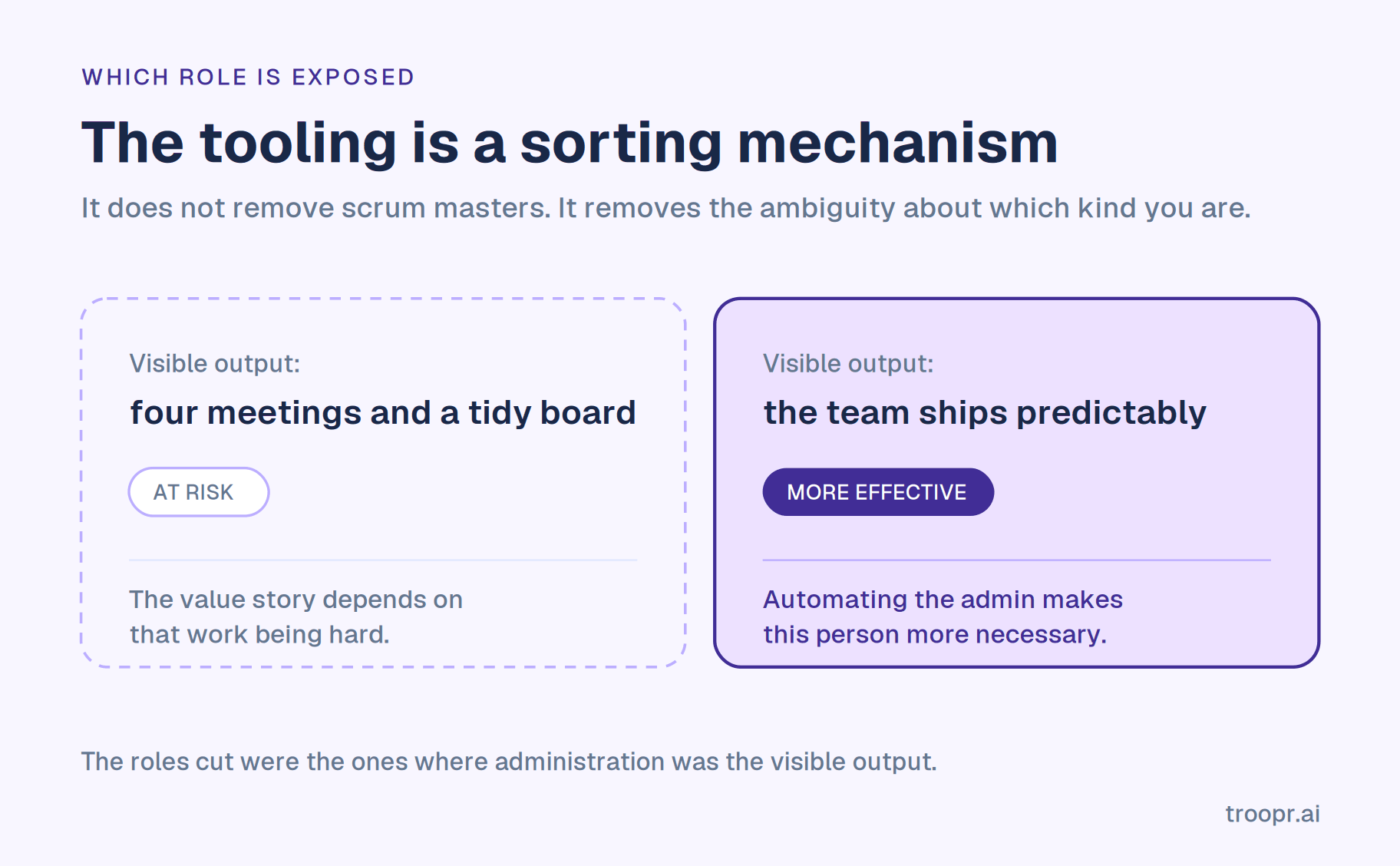
A scrum master whose visible output is running four meetings a week and keeping a board tidy has a value story that depends on those activities being hard. Once they are not hard, the story collapses, and it collapses whether the thing that made them easy is AI, a reorganisation or a manager who decides to run standup themselves.
A scrum master whose visible output is that the team ships more predictably, that dependencies get caught before they bite, that a difficult product relationship got fixed, has a value story tied to outcomes. Automating the admin makes that person more effective, not less necessary.
The uncomfortable implication is that the tooling is a sorting mechanism. It does not remove scrum masters. It removes the ambiguity about which kind you are.
How to make yourself hard to replace
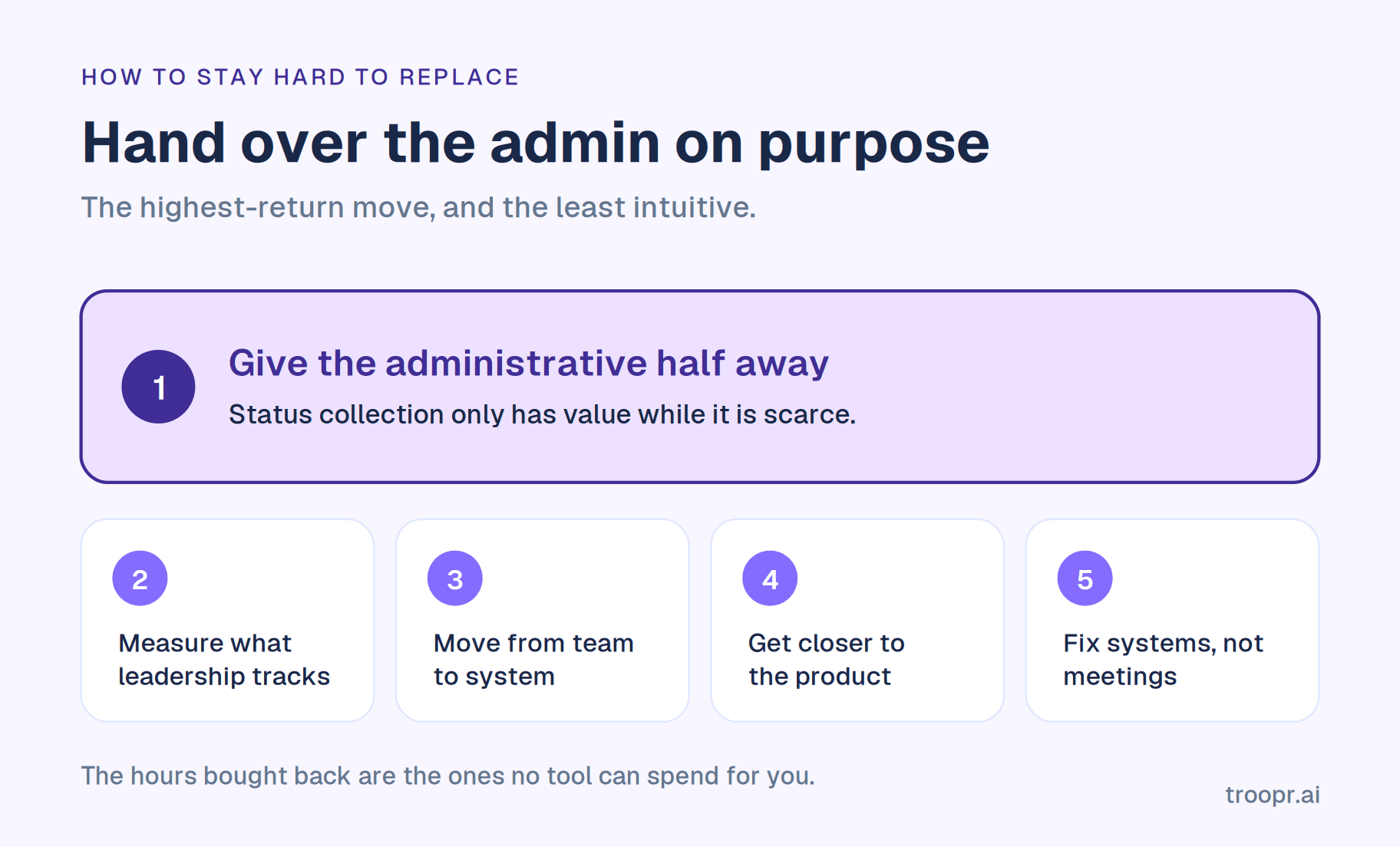
Give the administrative half away deliberately. Counterintuitive, and the single highest-return move. Automating status collection does not reduce your value unless status collection was your value. It buys back the hours that let you do the work nobody can automate.
Measure something leadership already cares about. Cycle time, predictability of delivery, escaped defects, how long work sits waiting. Roles get cut when nobody can articulate what changes if they go. Make that articulable with numbers you did not invent.
Move up the stack from team to system. The problems that survive automation are cross-team: dependencies, handoffs, the queue between two groups with different priorities. Nobody has automated the negotiation.
Get closer to the product and the business. The hybrid roles absorbing scrum master work, delivery manager and technical program manager, are not harder, they are wider. The gap is usually commercial context rather than agile skill.
Be the person who fixes systems, not the person who runs the meeting. If your retrospectives produce actions that get done, you are doing something structurally different from someone who facilitates a good conversation.
Learn the tooling properly. Our comparison of AI tools for scrum masters is a reasonable starting point, and the point is not to treat them as a threat. The practitioner who can set up a team's coordination so it runs without them is more valuable than one who performs that coordination manually, because the first one scales to three teams.
If you lead the function
For engineering directors and VPs deciding whether to keep, cut or consolidate these roles, the useful question is not whether AI can do the job. It is which half of the job you are actually buying.
If you are paying for coordination throughput, status collection, reporting, chasing, that is now largely a tooling cost rather than a headcount cost, and the honest answer is that the headcount is poor value.
If you are paying for team effectiveness, the capability to improve how a team works, that is not a tooling purchase and never will be. The common mistake is cutting the second while thinking you are cutting the first, then discovering eighteen months later that nobody owns improvement and the teams have quietly got worse.
One practical test. Ask what would stop happening if the role went. If the answers are all artifacts, reports, updated boards, meeting notes, you have an automation opportunity. If the answers are about behaviour, you have a person doing something you cannot buy.
Where tooling actually fits
Troopr is the AI project management agent for engineering teams. We should be straightforward about the self-interest here: we sell the thing that automates the administrative half of this role, and it is on the public record as an AI scrum master.
What we do not claim is that it replaces anyone. It is built to take the reconstruction work, not the judgement.
It reads each person's Jira activity, their pull requests and commits including the code diffs behind them, and the team's Slack channels, then forms its own view of what the team is doing. The standup is drafted from that rather than collected, which is why it still works on a day nobody meets. Snowflake's engineering teams eliminated roughly 86% of their weekly status-meeting time this way.
When the record and reality disagree, it proposes the correction to whoever owns the work. Each proposal is typed from a closed vocabulary, carries its evidence, is re-validated against live Jira state at the moment of confirmation, and runs under that person's own Jira login. No model writes to your board on its own, which matters here specifically: a tool that quietly rewrites your tracker is not reducing your workload, it is adding an audit you now have to perform.
Retrospectives, planning poker and team mood run as check-in types, async at each person's local time, with retro action items becoming linked Jira issues so improvements survive the week they were agreed. Routines are standing instructions in plain English, and any of them can stay silent until its condition is true. Ask Troopr answers questions about team state directly, which is what takes you out of the middle as the only route to the information.
Roku reported roughly a 45% reduction in context switching between Slack and Jira, about 1.8 focused hours back per engineer per day. Netflix's engineering team reported roughly 67% less time finding and updating Jira issues.
The hours that come back are the point. They are the hours that let a scrum master do the work this entire article says cannot be automated. Standups, retrospectives, estimation and reporting all run in one app in Slack, on every plan including Free.
Slack and Microsoft Teams, with two-way Jira sync across Cloud, Server and Data Center, and GitHub read-only. SOC 2 Type II, ISO 27001 and GDPR, no training on customer data. Free forever for 10 seats with every feature, then $6 per seat per month billed annually, and only people who take action count as seats.
Conclusion
AI will not replace scrum masters. It is already replacing a version of the scrum master job, the one defined by collecting information and relaying it, and that version was in trouble before the tooling arrived.
The practitioners who come out of this well are the ones who hand over the administration on purpose and spend the recovered time on the things that only a person can do. That is not a defensive move. It is the version of the role that was always supposed to exist, and most people never got the hours to do it.

Frequently asked questions
Will AI replace scrum masters?
No. AI automates the administrative part of the role, producing status, keeping the tracker current, assembling reports and preparing ceremonies. It cannot coach, create psychological safety, read team dynamics, hold a boundary with a stakeholder, or be accountable for a team's effectiveness. The roles genuinely at risk are the ones where administration was the visible output, and those were already under pressure before AI tooling was good enough to matter.
Are scrum master jobs disappearing?
Dedicated, ceremony-focused postings have contracted, and that is real. The responsibilities have mostly been absorbed into engineering manager, delivery manager and technical program manager roles rather than eliminated. Be sceptical of the numbers on both sides: widely repeated growth figures tend to originate with certification sellers, and the dramatic decline percentages often rest on very small samples.
Is AI the reason scrum master roles are being cut?
Mostly not. The contraction tracked the end of cheap-money hiring, a shift toward flatter teams, and scepticism about roles whose output leadership could not tie to shipped software. AI arrived after that and removed the last administrative justification for the headcount, which accelerated an existing trend rather than starting one.
What can an AI scrum master actually do?
Draft and post the daily standup from real activity, flag contradictions between what was said and what the tracker and code show, propose corrections to the tracker for an owner to confirm, run retrospectives and estimation async, deliver sprint reporting into chat, and answer plain-language questions about team state. For the full picture, see our guide on what an AI scrum master is.
How can scrum masters stay relevant?
Automate the administrative half deliberately rather than defending it. Measure something leadership already cares about, such as cycle time or delivery predictability. Move from single-team facilitation to cross-team coordination, where the problems are negotiations rather than process. Build commercial and product context, since the hybrid roles absorbing this work are wider rather than harder. And learn the tooling well enough to set up coordination that runs without you, which is what lets you cover three teams instead of one.
Should I still get a scrum master certification?
It still helps you get shortlisted and it is a reasonable entry point, but it no longer differentiates on its own, because certification volume kept growing while dedicated postings fell. What hiring managers screen for now is demonstrated outcomes. Treat the certificate as a baseline rather than the case for hiring you.
Will AI replace agile coaches too?
Less so, if anything. Coaching is further from automation than facilitation is, since almost none of it produces an artifact a tool could generate. The same market pressure applies to the title, though, and coaches have seen similar contraction for the same organisational reasons.
What should engineering leaders do about this?
Separate what you are buying. Coordination throughput is now largely a tooling cost rather than a headcount cost. Team effectiveness is not a tooling purchase and will not become one. Ask what would stop happening if the role went: if the answers are all artifacts, you have an automation opportunity; if they are about behaviour, you have a person doing something you cannot buy.


The AI project manager for engineering teams. Forms its own view of the work and does the coordination, right where your team already works.
101 Arctic Circle, Round Rock, Texas 78664, United States.