

What Is an AI Scrum Master? How It Works and How Agile Teams Benefit
An AI scrum master is software that takes over the administrative half of the scrum master role: collecting the standup, keeping the tracker honest, surfacing what is stuck, and preparing the ceremonies so they are worth holding.
It does not replace the person. The part of the role that matters most, coaching a team, facilitating a hard conversation, noticing that two engineers have stopped talking, is not automatable and will not be. What is automatable is the reporting layer that has accumulated around it, and on most teams that layer is where the week goes.
This guide covers what an AI scrum master is, what it does day to day, what it genuinely cannot do, when it is worth adopting, and how to tell the categories apart when every vendor uses the same two words.
What is an AI scrum master?
An AI scrum master is a tool that uses a language model to run the mechanics of scrum for a team: producing the daily standup, running retrospectives and estimation, reporting on sprint progress, and flagging risks like stalled or unassigned work.
The useful distinction between products is not model quality. It is two things: what the AI can see, and what it is allowed to do.
What it can see. A tool that reads only what people type into it knows only what people remembered to say. A tool that reads the tracker, the code host and the team's conversations can tell you that a pull request merged on Tuesday while the ticket still says in progress. That gap is where sprints go wrong, and it is invisible to anything working from self-reported status.
What it is allowed to do. Some tools only tell you things. Some draft changes to the tracker and ask a person to confirm. A few write directly. The middle option is where the useful ground sits, because a wrong write is worse than a missing one and the scrum master inherits the mess either way.
AI scrum master vs standup bot
A standup bot messages each person a set of questions on a schedule and posts the answers. That is a collection mechanism, and a good one, but the meeting has simply moved into chat. Everyone still writes their own update, and the update is still a memory exercise.
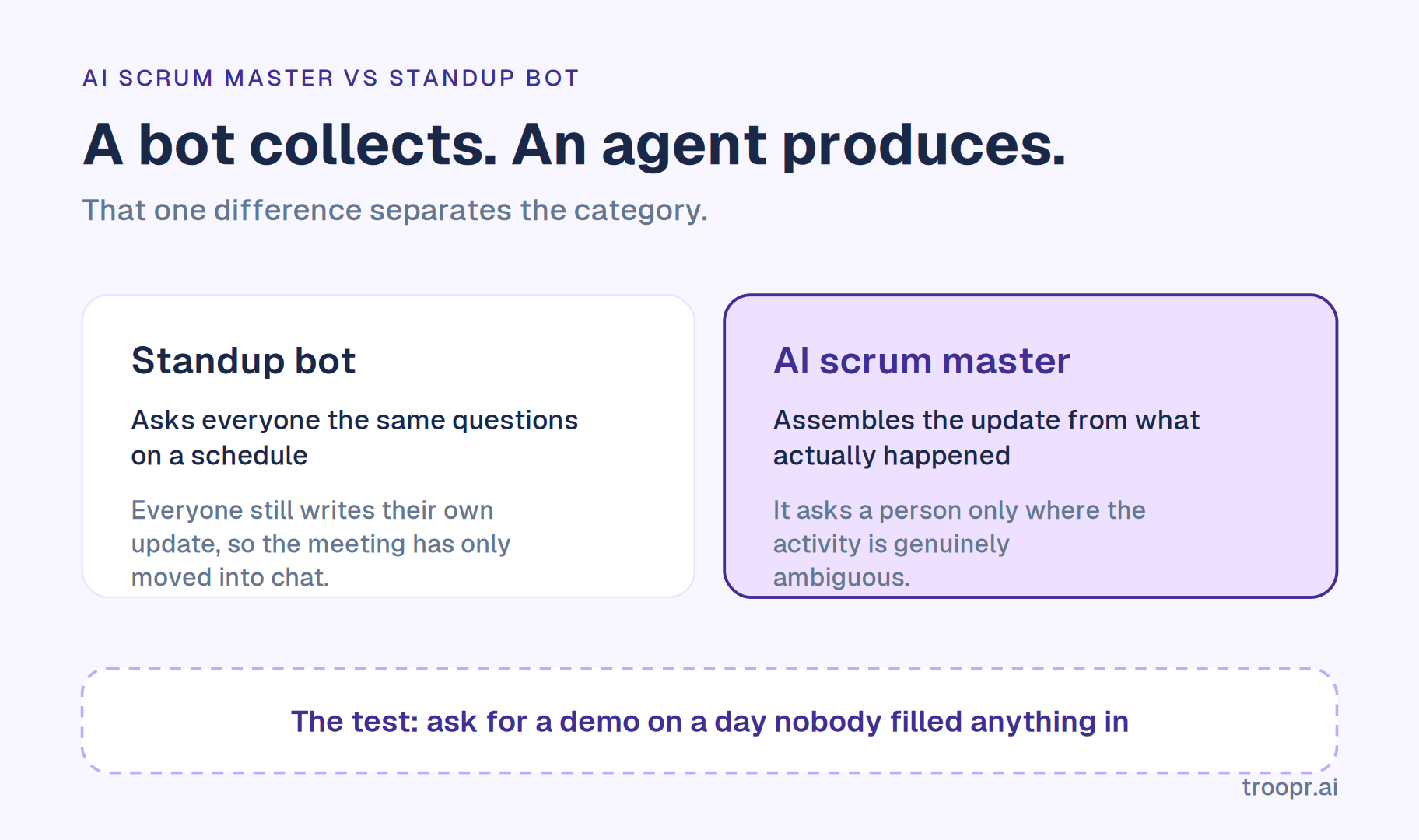
An AI scrum master is defined by producing the thing a standup bot collects. It assembles the update from what actually happened, then asks a person only where the activity is genuinely ambiguous. If a product calls itself an AI scrum master but still requires every person to type their status, it is a standup bot with a summariser attached. For a row-by-row view of that contrast against the best known standup bot, see Troopr compared with Geekbot.
How AI is redefining the scrum master role
The role was defined around accountability for a team's effectiveness. In practice it has drifted toward being the human reconciliation layer between three systems: work discussed in chat, tracked in Jira, shipped in GitHub. Keeping those three telling the same story is most of the job and none of the point.
Three forces are pulling it back.
Status is becoming a read rather than a report. The direction across the category is that the tool forms its own picture from real activity and people correct it, instead of people producing the picture from memory. The verbal round-robin standup is the ritual most exposed by this, and it is already going on distributed teams.
Tools are moving from telling to doing, with a confirmation step. Noticing that a ticket is wrong is easy. The interesting boundary is whether the tool can propose the fix, route it to whoever owns the work, and write it only once that person agrees.
AI contributors are adding coordination load, not removing it. Coding agents raise output per engineer, and every additional contributor adds coordination cost. More work shipping through the same team means more reconciliation, which is precisely the work a scrum master absorbs.
The net effect is a role with less administration and more of what it was supposed to be. For a scrum master covering three teams, this is the difference between relaying status and actually coaching any of them.
What does an AI scrum master actually do day to day?
Produces the daily standup. Drafts each person's update from their own tracker and code activity, posts the team report, and asks directly only where it cannot tell. On distributed teams this runs at each person's local time rather than forcing a shared slot, which is what makes an async standup hold rather than fade after a month.
Flags contradictions. The ticket marked done that is still in review. The blocker with no owner. The pull request nobody mentioned. These are findable only by cross-checking what was said against what the tools show.
Keeps the tracker current. When work visibly happened but the record does not reflect it, the tool drafts the change and routes it to the owner. Nothing is written until a person confirms. This is the part that keeps Jira best practices alive after setup, rather than decaying the week everyone gets busy.
Runs the ceremonies. Retrospectives, scheduled estimation rounds and team sentiment, collected async and synthesised into themes rather than a wall of notes. Action items become tracked work rather than notes in a doc. The wider category is covered in our guide to the best scrum tools for Slack.
Reports on the sprint. Burndown, velocity, what shipped, what is piling up, what is overdue, delivered on a schedule as a Jira report in Slack rather than a dashboard someone has to remember to open.
Answers questions. What shipped this week, who is blocked, where the risk is, asked in plain language and answered from the team's real activity rather than a model's general knowledge.
Watches quietly. The most underrated behaviour in the category. A standing check that posts only when its condition is true, so silence is itself information and nobody is reading a daily digest for the one line that matters.
What an AI scrum master cannot do
Being precise here matters, because the category name oversells and this reader verifies.
It cannot coach. Developing a team, having the difficult conversation with an overcommitting product owner, building the safety that makes a retrospective honest. None of this is a data problem.
It cannot read the room. Hesitation in an answer, two people who have quietly stopped collaborating, the engineer whose updates have gone flat for three weeks. A transcript does not carry this and a tracker certainly does not.
It cannot set priority. Priority is a judgement about value and risk that depends on context the team holds. A tool that ranks your backlog is either guessing or applying someone else's weighting.
It should not replace estimation. The value of estimating is the disagreement it exposes between two engineers who read the ticket differently. A model producing a number skips the conversation that was the point.
It cannot own the outcome. Accountability for a team's effectiveness sits with a person. Nothing on the market changes that, and any vendor implying otherwise is selling.
When should you use an AI scrum master?
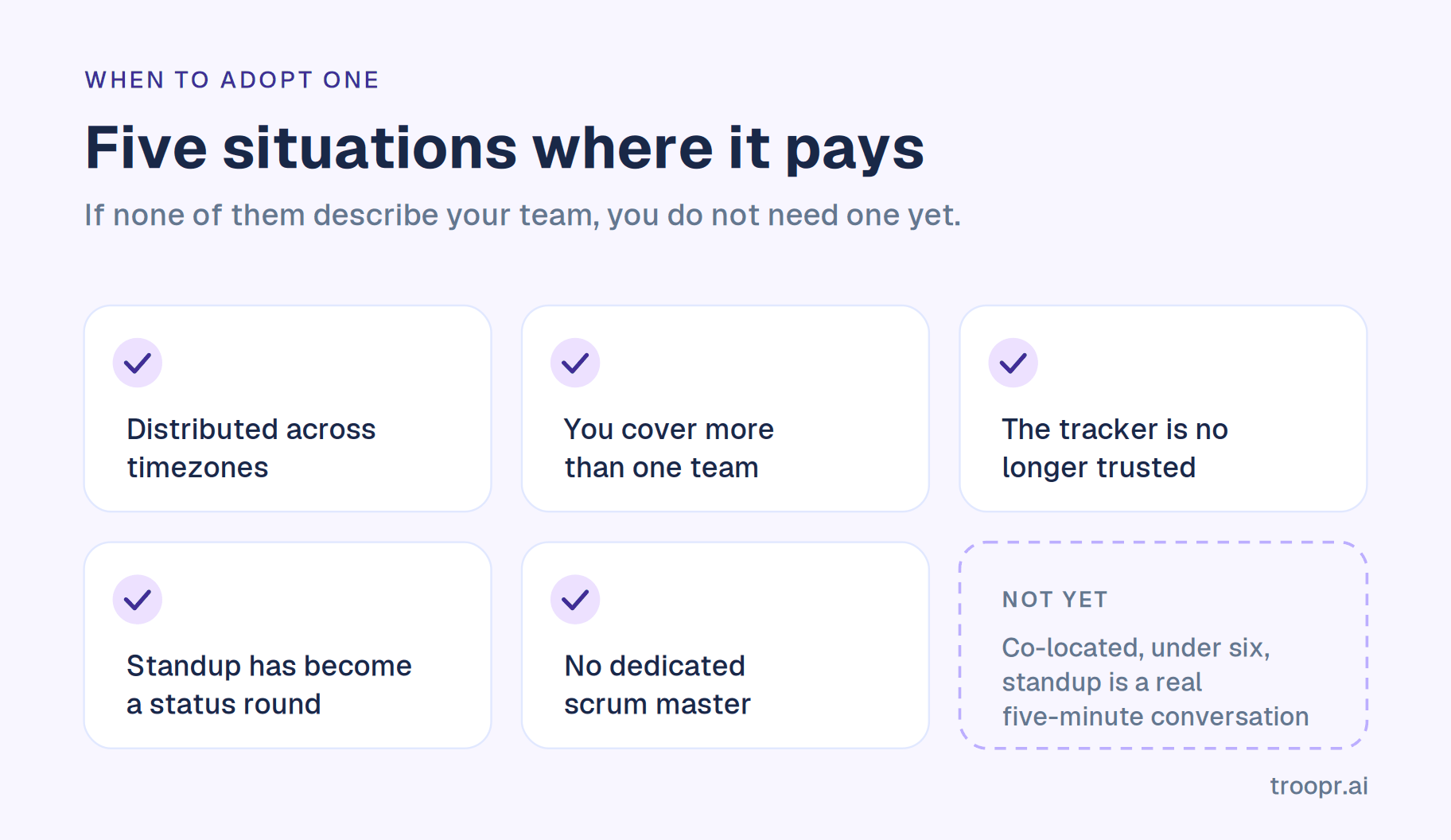
The case for AI for scrum masters is strongest in five situations. If none of them describe your team, the honest answer is that you do not need one yet.
Your team is distributed across timezones. The clearest case. There is no good shared slot, forcing one costs somebody their evening every day, and async ceremonies only work if something synthesises the input into a view worth reading.
You cover more than one team. A scrum master with one team can hold the picture in their head. With three they cannot, and the role degrades into status relay. This is the point where the tooling pays for itself.
Your tracker has stopped being trustworthy. If planning starts with a reconciliation exercise, or leadership has quietly stopped believing the board, the problem is hygiene and it compounds.
Standup has become a status round. If people are reading their ticket list aloud to one person, the ceremony has stopped being a planning event and the information is already visible elsewhere.
You have no dedicated scrum master. Common on engineering teams, where an engineering manager or tech lead absorbs the role on top of their own job. This is where the administrative load does the most damage.
When not to. If your team is co-located, under about six people, and the standup is a genuine five-minute conversation, you do not have a coordination problem. Buying a tool for it adds a step.
Benefits of AI for agile teams
Hours back per sprint. The reconstruction work, chasing status, reconciling the tracker against what shipped, writing the update, is the largest single block of coordination time on most teams. Snowflake's engineering teams eliminated roughly 86% of their weekly status-meeting time after moving to automated check-ins.
Status that reflects reality. Self-reported status is a memory exercise. Status derived from activity is a measurement. The difference shows up first in planning, where estimates stop being built on a fictional starting position.
Less context switching for engineers. Every trip from chat to the tracker to answer a question costs more than the minute it takes. Roku reported roughly a 45% reduction in context switching between Slack and Jira, about 1.8 focused hours back per engineer per day.
Ceremonies that survive a busy sprint. Retrospectives and refinement are the first things dropped under pressure. Running them async lowers the cost enough that they hold.
The manager stops being the relay. Leadership can read the team's state directly instead of routing every question through one person, which removes a bottleneck and a single point of failure.
Fewer tools and fewer bills. A standup bot, a retro tool, a report scheduler and a tracker integration is four subscriptions producing four partial pictures of the same team. Consolidation saves money and, more usefully, reconciliation.
A record that outlives memory. Searchable history of what was decided and what changed is how a new joiner learns why the team works the way it does, and how you notice the same blocker has appeared in five consecutive sprints.
How AI scrum masters work in practice
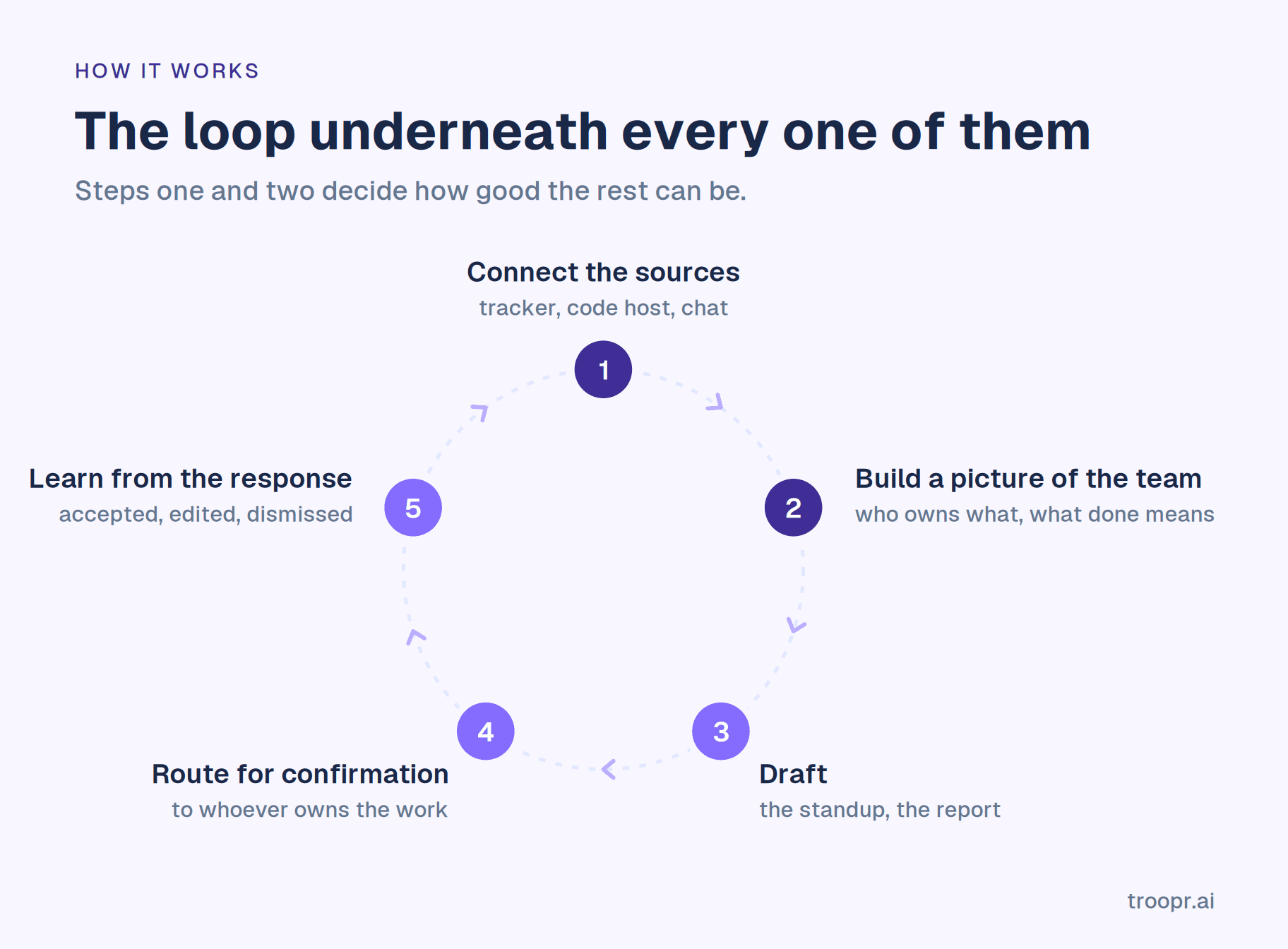
Under the branding, these products run a version of the same loop.
1. Connect the sources. The tracker, the code host, the chat platform, and sometimes the meeting itself. Coverage here sets the ceiling on everything after it, because the tool can only reason about what it can see.
2. Build a picture of the team. Who owns what, what done means using your real status names, your cadence, where work repeatedly stalls. The products that improve with use are the ones that persist this; the ones that restart from zero each morning stay generic.
3. Draft. The standup update, the sprint report, the retro summary, assembled from activity rather than requested from people.
4. Route for confirmation. Anything that changes the record goes to the person who owns the work, carrying the evidence it was based on, and is re-checked against live state at the moment they confirm so a stale proposal does not get written.
5. Learn from the response. What people accept, edit and dismiss is the training signal. A tool that gets corrected the same way twenty times and keeps proposing the same thing is not learning.
The honest summary is that steps one and two separate the products. Everything from step three onward is only as good as what came before it.
How to choose the right AI scrum master for your organization
Seven questions, in the order that narrows the field fastest. If you would rather start from a shortlist, we compare the field in the top AI tools for scrum masters.
1. Are you keeping your synchronous ceremonies? This fork eliminates half the market. If the team intends to keep meeting, a meeting-capture tool takes the follow-up work off you. If the ceremonies are what you are trying to shrink, a meeting tool has nothing to work from on days you do not meet.
2. What can it see? Tracker only, or tracker plus code plus chat. Ask specifically whether it reads pull requests and commits, because that is what lets it catch the gap between shipped and recorded.
3. Does it write the update or collect it? Ask for a demo on a day nobody filled anything in. The answer is immediate. Tools built around scrum process menus tend to collect and then export one way, which Troopr compared with Standuply sets out in detail.
4. What is the confirmation model? Whether a human approves before anything is written, whether the write runs under that person's own credentials and permissions, and whether the proposal is re-validated at the moment of confirmation.
5. Which tracker variants are supported? Jira Cloud, Server and Data Center are not interchangeable, and plenty of tools support only Cloud. Check which plan the integration sits on too; gating the tracker behind a top tier is common.
6. How is the AI priced? Most of this category now meters AI usage in credits on top of the seat price, which is awkward for workflows you want running daily. Work out what a fortnight of standups plus a retro consumes, whether the pool is per user or shared, and what happens when it empties mid-month. Atlassian starts charging for Rovo credits above the allowance in December 2026, which Troopr compared with Rovo works through with the numbers.
7. Will it clear security review? Ask for the certifications and the procurement package by name and read the wording carefully. Designed to SOC 2 aligned standards is not the same as holding the report. Ask whether customer data trains the model.
Meet Troopr: your AI scrum master
Troopr is the AI project management agent for engineering teams, and its AI scrum master is built for the second answer to question one: teams trying to shrink the ceremony overhead rather than document it.
It reads each person's Jira activity, their pull requests and commits including the code diffs behind them, and the team's Slack channels, then forms its own view of what the team is doing. On top of that sits a per-team memory: who owns what, what done means using your real Jira status names, your cadence, and where work repeatedly stalls. Every report and answer comes from that rather than from a model's general knowledge.
The standup writes itself. Each person's update is drafted from their own real activity and posted to the team channel, asking someone directly only when it genuinely cannot tell what they are working on. If your team keeps the live standup, Troopr joins on Google Meet, Zoom or Microsoft Teams as a silent participant, announces itself, listens with speaker attribution, and cross-references the recap against live Jira and GitHub state rather than transcribing one call. Live and async updates merge into one report.
It flags what does not add up. The ticket marked done that is still in review, the blocker with no owner, the pull request nobody mentioned. Every insight links back to its source, a Jira ticket, a pull request, a commit or a Slack thread, so anyone can verify it.
It proposes the Jira changes that follow. Each proposal is typed from a closed vocabulary, carries its evidence, is routed to the person who owns the work, and is re-validated against live Jira state at the moment of confirmation. The write runs under that person's own Jira login. No model writes to your tracker on its own.
The ceremonies run in chat. Retrospectives, planning poker and team mood run as check-in types on the same team, async at each participant's local time, with anonymous submission where it counts and retro action items becoming linked Jira issues.
Reporting is a standing instruction, not a chart builder. Routines are written in plain English. A report reads Jira and changes nothing; a proposal offers a change nobody writes until a person confirms. Any of them can stay silent until its condition is true, so hearing nothing means nothing is wrong.
And you can just ask. Ask Troopr answers plain-language questions on team state in the web app, by Slack DM, or with a slash command in any channel, returning the answer privately.
Stack and security. Slack and Microsoft Teams. Jira Cloud, Server and Data Center, with two-way sync so a decision in a thread reaches the ticket. GitHub read-only by design. SOC 2 Type II, ISO 27001 and GDPR, OAuth that inherits Jira permissions, no training on customer data, no raw message storage. Netflix's engineering team cited the internal security clearance as a deciding factor and reported roughly 67% less time finding and updating Jira issues.
Pricing. Free forever for 10 seats with every feature included and no credit card. Standard is $6 per seat per month billed annually, $8 monthly. Only people who take action count as seats, so anyone who just reads is free, and nothing the AI produces is metered.
Standups, retrospectives, estimation, sprint reporting and Jira issue management all run in one app in Slack, on every plan including Free. Troopr has served 600+ engineering teams, including Netflix and Snowflake.
Conclusion
The question is not whether an AI scrum master can replace you. It cannot, and the products that matter are not trying to.
The question is which half of your week you want back. If it is the reconstruction work, chasing status, reconciling the board against what shipped, preparing ceremonies so they are worth holding, that is the half this category actually removes, and it is the half that grows every time another team gets added to your name.
When you trial one, run a single test. Stop updating the board for three days, then ask the tool what the team is doing. Anything that only summarises will give you a confident, fluent, wrong answer.
Frequently asked questions
What is an AI scrum master?
An AI scrum master is software that automates the administrative part of the scrum master role: producing the daily standup, keeping the tracker current, running retrospectives and estimation, reporting on sprint progress, and flagging stalled or unassigned work. The better tools build their picture from real activity in the tracker, the code host and chat rather than from what people type into a form.
Will an AI scrum master replace scrum masters?
No. It automates the reporting layer, not the role. Coaching a team, facilitating a difficult conversation, building the psychological safety that makes a retrospective honest, and owning accountability for the team's effectiveness are not data problems. The realistic outcome is that the administrative half shrinks and the coaching half gets the time back.
What is the difference between an AI scrum master and a standup bot?
A standup bot asks each person your configured questions and posts their answers, so the meeting has moved into chat but everyone still writes their own update. An AI scrum master produces the update itself from real activity and asks a person only where the activity is ambiguous. If a product still requires every person to type their status, it is a standup bot with a summariser attached.
What does an AI scrum master do?
Day to day: drafts and posts the standup, flags contradictions between what was said and what the tools show, proposes updates to the tracker for the owner to confirm, runs retrospectives and estimation async, delivers sprint reporting into chat, answers plain-language questions about team state, and runs standing checks that stay quiet until something needs attention.
How accurate is an AI scrum master?
Accuracy is a function of what it can see, not of the model. A tool reading only its own database is limited to what people entered. One reading the tracker, the code host and chat can verify claims against evidence. The practical tests are whether every statement links back to a source you can check, whether a person's own correction overrides the inference, and whether contradictions are flagged openly rather than smoothed over.
Is it safe to let AI update our Jira?
It depends entirely on the confirmation model, which is the first thing to check. Ask whether the tool writes on its own or proposes a change for a person to approve, whether the write executes under that person's own credentials and permissions, and whether the proposal is re-checked against live state at the moment of confirmation. Troopr's model is that no write happens without human confirmation, each proposed action is typed from a closed vocabulary, and it runs under the confirming person's own Jira login.
Is AI useful for agile coaches as well as scrum masters?
More so, usually. A coach typically covers several teams and cannot hold all of them in their head, so a tool that reports across teams from real activity gives them something to work from that is not a manager's self-assessment. Meeting-capture tools are less useful in that role, since a coach is not in every ceremony.
Do small teams need an AI scrum master?
Not always. A co-located team of five whose standup is a genuine five-minute conversation does not have a coordination problem. The threshold is usually distribution across timezones, more than one team per coordinator, or a tracker that has stopped being trustworthy. That said, free tiers make this cheap to test, and our roundup of free Slack standup bots compares what each one actually gives you. Troopr's Free plan is permanent, covers 10 seats, and includes every feature.
How much does an AI scrum master cost?
Entry pricing in this category runs from roughly $2 to $19 per user per month, but the seat price is rarely the whole cost. Most tools now meter AI usage in credits on top of the subscription, which matters because the workflows you want are daily rather than occasional. Check the allowance, what a typical fortnight consumes, whether the pool is per user or shared, and what happens when it runs out. Troopr is $6 per seat per month billed annually, $8 monthly, with nothing the AI produces metered. We break the credit models down across the category in the best AI project management tools.
Does an AI scrum master work with Jira?
Most integrate at some level, but check which plan the integration sits on and which Jira variants are supported, because that is where the surprises are. Several tools are Jira Cloud only, and several put the Jira connector on their top tier. Troopr supports Jira Cloud, Jira Server and Jira Data Center on every plan including Free, with two-way sync rather than one-way ticket creation. If the official Atlassian app is your current baseline, Troopr compared with Jira Cloud for Slack covers where it stops.


The AI project manager for engineering teams. Forms its own view of the work and does the coordination, right where your team already works.
101 Arctic Circle, Round Rock, Texas 78664, United States.