

The status update meeting: how to run a good one, and how to need fewer

Twelve people, forty-five minutes, one decision. The decision took four minutes. The other forty-one were people reading out what the board already said, or should have.
A status update meeting is a recurring meeting, usually weekly, where a team shares progress, blockers, and risks so everyone leaves with the same picture of the work and makes the decisions that need a room.
That's the job description. The hour you actually sit through is mostly recital, and it exists for an uncomfortable reason: nobody trusts the board. Some teams have already stopped paying for it: Snowflake's engineering teams cut ~86% of their weekly status-meeting time once Troopr started assembling the status for them, with the Jira activity already attached. Below is how that works, next to everything you can do by hand next Monday.
What a status update meeting is for
Strip away the ritual and a status meeting has three real jobs:
- One picture. Everyone leaves knowing what shipped, what's moving, and what isn't.
- Early warning. Anything stuck, slipping, or about to bite gets said while there's still time to act on it.
- Decisions. The calls that genuinely need several people at once: a scope cut, a reassignment, a date that moves.
Only the third needs everyone in the same place at the same time. The first two are information, and information travels fine in writing. PMI's guide to running a status meeting lands in the same place: spend the meeting on issues and variances, and move routine status into regular status reports, because a room full of people hearing updates that need no action is time nobody gets back.
The names change by team. A weekly status meeting usually covers one team's work. A project status meeting pulls in stakeholders from outside the team, and the conversation drifts toward dates and asks. The daily standup is a different animal: the Scrum Guide defines the Daily Scrum as developers inspecting progress toward the Sprint Goal and adapting their plan, a planning conversation among peers rather than a report to a manager. If your standup has quietly become a daily status meeting, here's how daily standups are meant to work.
Why most of the hour is reading the board out loud
Here's the part most guides skip. If the board were current, nobody would need to say “still on the payments migration, should land Thursday.” The board would already say it. People recite status because the board doesn't hold it.
And it doesn't hold it for boring, universal reasons:
- A decision gets settled in a thread and never reaches the ticket.
- A PR merges on Tuesday and the ticket still says In Progress on Friday.
- A blocker comes up in Friday's standup and is gone from everyone's head by Monday.
So the manager calls a meeting to rebuild the picture by asking. Then something worse happens. Because the meeting is where status really lives, nobody updates the board between meetings. Why would you? You'll say it on Monday. The board drifts further, trust drops further, and the meeting gets longer.
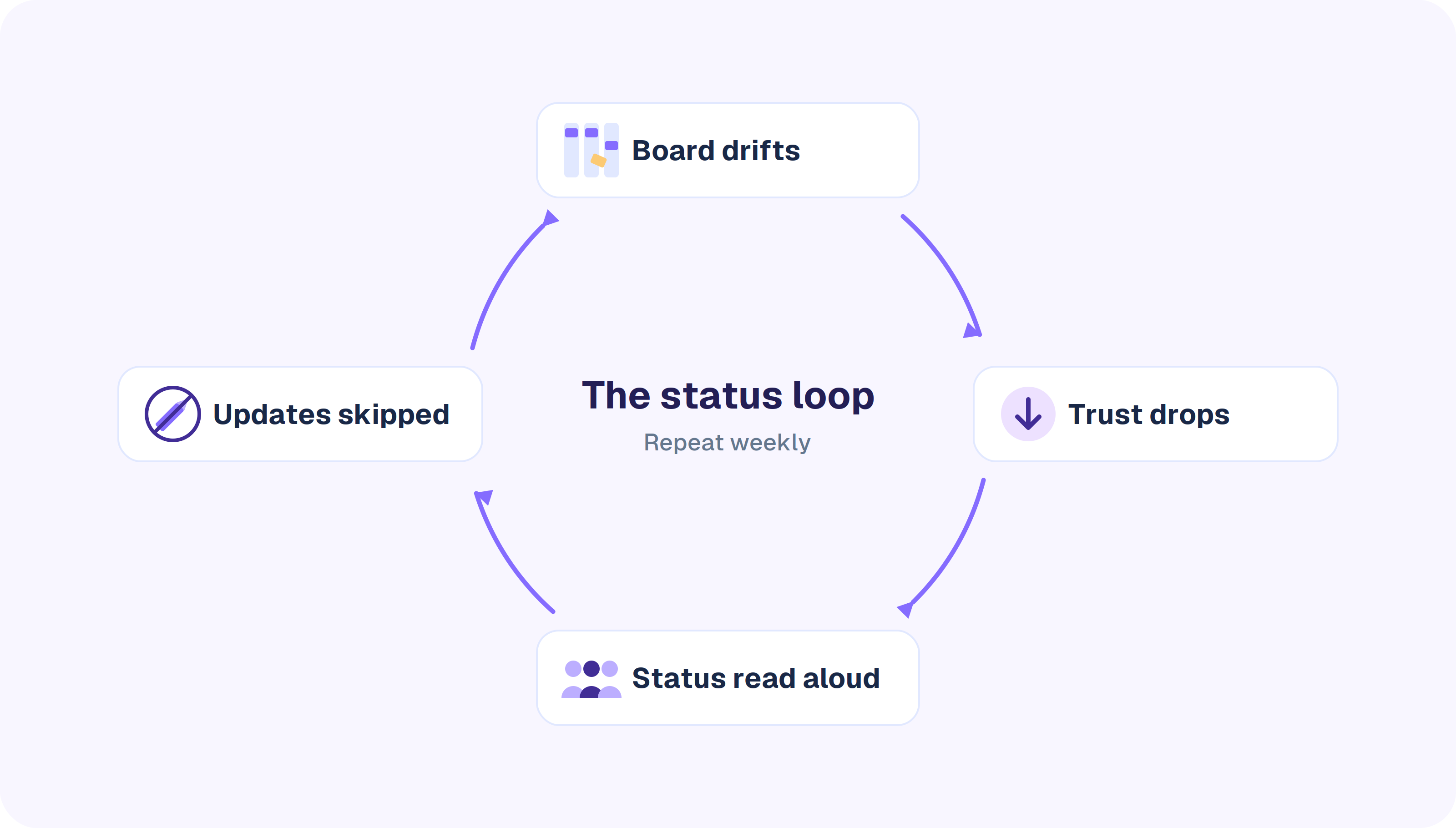
That loop is the real cost. Run the math on your own meeting: twelve people for forty-five minutes is nine person-hours a week, roughly 450 a year, most of it spent listening to updates that needed no reply. Multiply that across a calendar and you get the picture in Harvard Business Review's research on meeting overload: executives averaging nearly 23 hours a week in meetings, up from under 10 in the 1960s.
Breaking the loop from the board's side
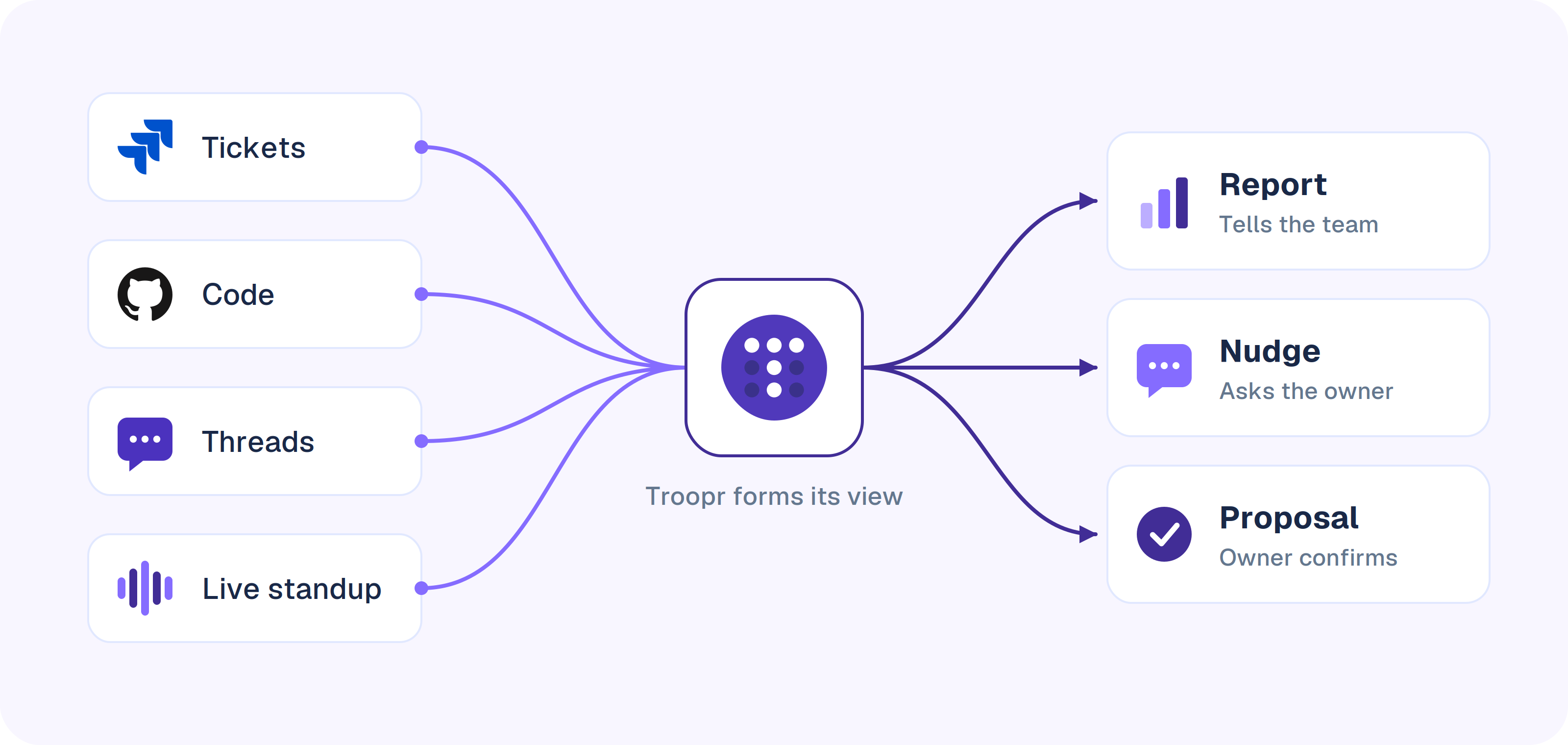
You can break that loop by hand, with discipline and a lot of reminding. Or you can break it where it starts, which is what Troopr does. Troopr is the AI project management agent for engineering teams: it reads the same signals you would, from tickets and pull requests to threads and the standup, and forms its own view of what actually changed.
Then it closes the gaps instead of reporting them. When a PR merges and its ticket still says In Progress, Troopr proposes the move to whoever owns the ticket, and they confirm with one tap. When something gets decided in a thread and no ticket covers it, it proposes one. Nothing is written until the owner confirms, and the change runs under their own Jira login. The board stays true without anyone nagging, so there's nothing left to read aloud.
Setup is a signup, a team channel, and your own Jira login, no admin ticket needed for the Jira part. Start for Free and point it at one team before your next status meeting. For the habits that keep any board current, see Jira best practices that keep the board honest. Next: how to run the meeting you still have this week.
How to run a good status update meeting
Until the recital goes away, you can at least stop paying for it live. Three rules do most of the work.
- Status is written before the meeting, not spoken in it. It lands in the team channel at a fixed time, and people read it before they join.
- Green is silent. If an item is on track and written down, nobody says it out loud. The meeting covers exceptions. Drop the round-robin: going around the table guarantees everyone speaks and nearly guarantees nobody listens.
- No decisions queued, no meeting. Whoever runs it checks the queue an hour before and cancels if it's empty. People will be surprised once and grateful every week after.
A 25-minute weekly status meeting agenda you can steal
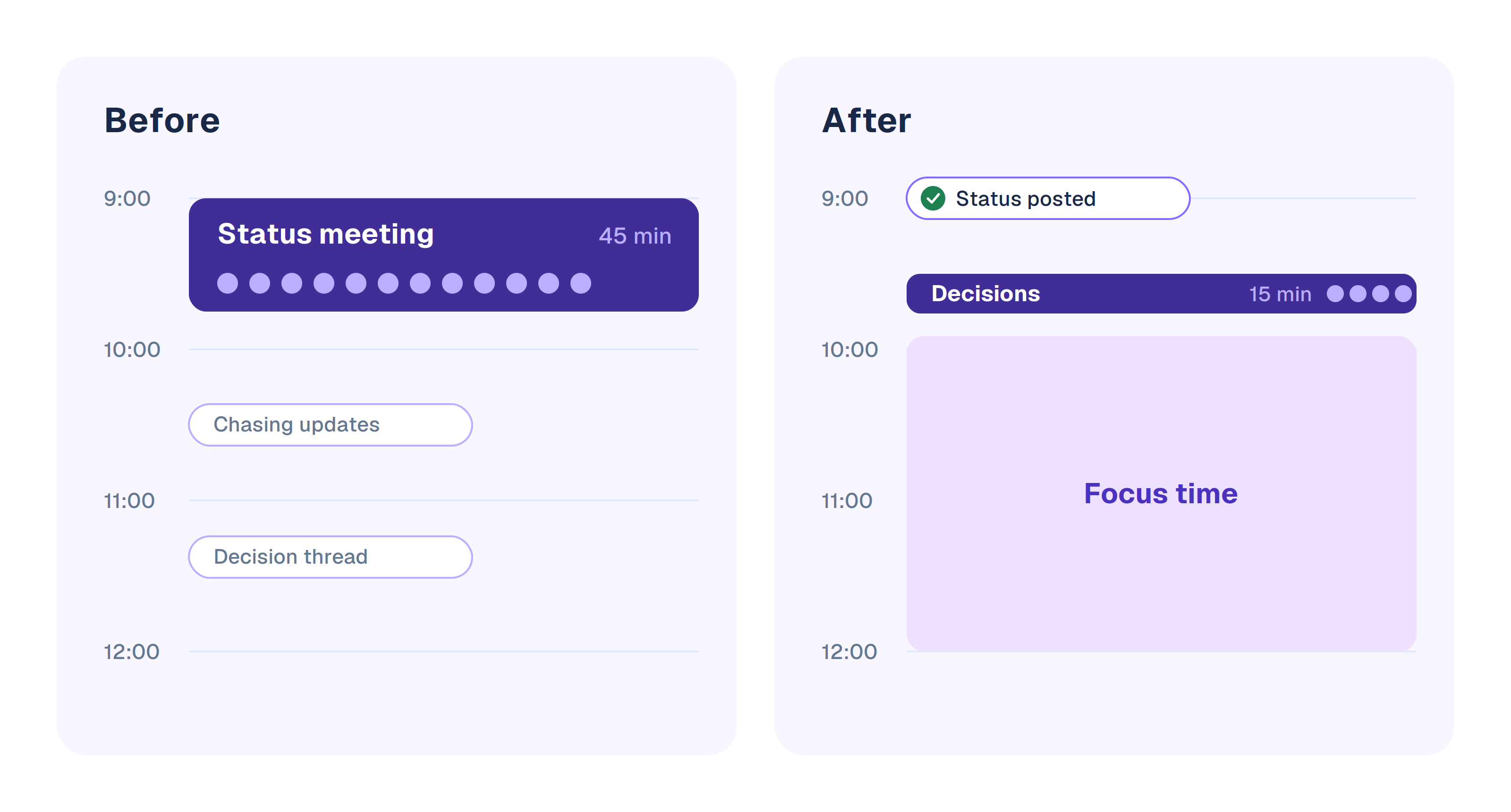
- Before the meeting, async. Written status lands in the channel by 9:00. Owners mark anything red or amber, and anyone can add an item to the decision queue.
- Minutes 0 to 3: what changed since it was written. Only news that broke after the status went out.
- Minutes 3 to 10: red and amber items. The owner says what's stuck and what they need. Problem-solving moves to a follow-up with just the people who can fix it.
- Minutes 10 to 20: decisions. Take the queue in order. Each one ends with a call and an owner, or the date by which it will be made.
- Minutes 20 to 23: risks and dependencies. What's coming next week that another team needs to hear about.
- Minutes 23 to 25: read back the actions. Owner, action, date. Post them in the channel thread straight after.
The shortcut: step 1 is the only part of this agenda that takes real work, and it's the part Troopr does. It writes each person's update from their own activity, asks only when it can't tell, and posts the team's read to the channel at 9:00. Everyone walks in having read it, and the gaps in the board have already gone back to their owners.
For a project status meeting with stakeholders, keep the shape and swap the decisions block for asks: what you need from them, and by when. Invite the people the decisions need. Everyone else gets the written status and their morning back.
If the team spans time zones, somebody is paying for this meeting at 10 p.m. The async approach in our guide to running standups for remote teams applies to the weekly meeting too.
Signs your status meeting should shrink or go
Most status meetings don't need cancelling outright. They need to get smaller until they're the size of the decisions inside them. Check yours:
| If this sounds familiar | It means | Do this |
|---|---|---|
| People read their update off the board, word for word | The board already holds it | Make those items written-only and drop the round-robin |
| The board only gets updated the hour before the meeting | The meeting is what keeps it current | Fix how the board stays current, then shrink the meeting |
| Most people speak only for their own update | They're there to report, not to decide | Send them the written status instead of the invite |
| The same blocker shows up three weeks running | Saying it isn't moving it | Give it one owner and a date, or escalate it |
| The real decision happens in a thread afterward | The room isn't where decisions get made | Only meet when the decision queue has something in it |
| Someone joins at 10 p.m. their time to say “no change” | Time zones are paying for the recital | Move status to async and keep a short overlap slot for decisions |
| Nobody noticed the week it got cancelled | It was a ritual | Leave it cancelled and see what breaks |
Status meeting alternatives: what replaces the read-aloud
Once status stops being spoken, it has to live somewhere. There are three places it can go, and they differ in one thing: how much of it is still somebody's job to produce.
Written updates in the channel
Everyone posts a short update on a schedule. GitLab's engineering handbook describes a version of this: anyone posting a program status update to the engineering announcements channel includes two or three sentences on what was completed and what's blocked or at risk. It's a big step up from the meeting. The catch is that someone still writes it from memory, and someone still chases whoever didn't.
The board as the source of truth
Make the tracker the record and point everyone at a dashboard. Right instinct, and only as good as the last time somebody updated a ticket. Which puts you straight back in the loop above.
Status formed from what actually happened
The third option skips the writing. Instead of asking people to describe their week, read the week: tickets that moved, pull requests that merged, decisions made in threads, what was said in standup. The status is assembled from the work itself, and people only fill in what can't be seen.
| Weekly status meeting | Written updates | Troopr: formed from real activity | |
|---|---|---|---|
| Who does the work | Everyone, live, at the same hour | Each person writes their own | Troopr drafts it; people correct what's wrong |
| Built from | What people remember to say | What people remember to write | Tickets, pull requests, threads, and the standup |
| Current as of | The meeting | Whenever it was written | The moment it posts |
| Catches a mismatch | If someone happens to notice | Rarely | Flags it: what was said against what moved |
| Weekly cost, team of 12 | 9 person-hours | A few minutes each, plus chasing | Reading time |
| Left for a meeting | Decisions, if there's time after the recital | Decisions, if anyone calls one | Decisions, with the picture already shared |
Cost row assumes 12 people in a 45-minute meeting. Swap in your own numbers.
When status is already true, the meeting shrinks to the decisions
That third option is what Troopr runs all week. You've seen it keep the board true. Here's what it does to Monday.
The standup writes itself. Troopr drafts each person's update from their own activity and posts it to the team channel, asking someone directly only when it genuinely can't tell what they're working on. If the team still meets live, Troopr can join the call on Meet, Zoom, or Teams, listen, and post a recap checked against Jira and GitHub, with anything that doesn't match flagged openly. That's Check-ins.
The status posts itself, on your schedule. A routine is a standing instruction written as a sentence, like “post the team's read every Monday at 9.” Troopr runs it and posts a narrative read on the team: what's in progress, in review, ready to deploy, and shipped, plus a needs-attention section that names specific people and specific items, each with a suggested next step. The said-versus-moved report goes further and lines up what people committed to in check-ins against what actually moved in Jira, which is the conversation most status meetings are trying to have. That's Routines, and if all you need this week is the burndown in the channel every Monday, it's one routine: Jira reports in Slack.
Quiet means fine. Any routine can run as a watch, silent unless something is wrong, so a quiet channel means nothing needs you, not that nothing is running.
Put those together and Monday looks different. The picture is in the channel before anyone opens a laptop. The red items are already named, with owners. The board is true because the gaps were proposed back to their owners during the week. What's left for the room is the decision queue, and that rarely needs forty-five minutes or twelve people.
Snowflake's engineering teams got there by moving a weekly sync that spanned time zones into async check-ins that arrive with the Jira context attached. Yahoo's process-automation team swapped ad-hoc pinging for the same thing and gave each manager back ~3.8 hours a week on meeting logistics.
~86%
of weekly status-meeting time eliminated
Snowflake engineering, Jira Cloud, teams across time zones
Read the Snowflake story~3.8 hrs
a week back for each manager on meeting logistics
Yahoo, distributed process-automation team
Read the Yahoo storyLet Troopr write Monday's status.
$6 per seat/month. Everything included. Free for 10 seats, no credit card.
Troopr runs in Slack and Microsoft Teams. Free covers 10 seats, 3 synced channels, and 3 routines, with every feature and no credit card, and people who only read are free on every plan.
Status update meeting FAQ
What is a status update meeting?
A status update meeting is a recurring meeting, usually weekly, where a team or project group shares progress, blockers, and risks and makes the decisions that need several people. Done well, it covers exceptions rather than a round-robin of everything that went fine.
Which items should the team discuss during a status update meeting?
Only what needs the room: work that is blocked, slipping, or at risk, decisions waiting on someone, and dependencies on other teams. Anything on track and already written down can be read before the meeting.
What is another word for a status update meeting?
Status meeting, weekly sync, check-in, or progress meeting. The daily version on engineering teams is the standup or daily scrum, and the version with stakeholders is usually called a project status meeting.
What should a weekly status report contain?
What finished since the last report, what's in progress, what's blocked or at risk and who owns it, decisions needed and by when, and what's planned next. Link each item to its ticket so readers can check the detail without asking.
When participating in a project status meeting, what is important for a participant to do?
Read the written status first, speak to exceptions and blockers rather than recite progress, and leave with any action clearly owned and dated. If nothing is red, saying so in one line is a complete update.
What are the four types of meetings?
One common split is status update meetings, decision-making meetings, problem-solving meetings, and team-building meetings. Status updates are the easiest to move into writing, because they share information without needing discussion.
Next week, try one thing: post the status before the meeting and only talk about what's red. If the meeting gets shorter, you've just measured how much of it was recital. If you'd rather nobody had to write the status at all, Start for Free and let Troopr draft Monday's.


The AI project manager for engineering teams. Forms its own view of the work and does the coordination, right where your team already works.
101 Arctic Circle, Round Rock, Texas 78664, United States.